A Forest of Dean summer: whinberries, dragonflies, and a swimming pool that was a birthday present
What summer is actually for in the Forest of Dean: foxgloves flooding the felled clearings, whinberries ripening low in the July heath, dragonflies over ponds the ironworks left behind, a volunteer-run open air pool given to a town in 1920, and a waterfall a vanished estate forgot to take with it. Where the season lives, the one rule about the water, and the lakes where you really can get in.
whimsee field notes · Forest of Dean · 6 August 2026
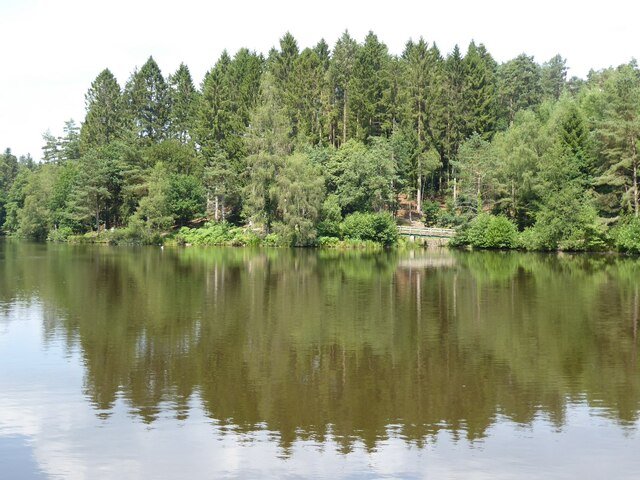
For most of the year the Forest of Dean is about trees. Then summer turns up and the whole place is suddenly about water and light instead. The canopy shuts overhead, the heat stays outside it, and everything you actually want to walk to is a pond, a pool, a waterfall, or a gap where the sun gets in.
First, the purple
Summer here announces itself in the felled ground. Wherever the foresters have cleared a block, the next few summers run purple with foxgloves, sometimes thousands of them at once, and the explanation is patience. One foxglove drops tens of thousands of seeds. They sit in the soil for years, viable, waiting for light, and felling is what finally gives it to them.
Which means the spikes you walk past in June stood in that seed bank through every year the plantation was growing over them. Bees work the purple all day long. It is one of the few sights in forestry that looks like damage and is actually the ground collecting on an old debt.
Then, the whinberries: picking bilberries in July and August
July into August, on the acid ground under the oaks and birches and out on the heathy patches, a low scrubby plant that has been anonymous since Christmas starts carrying small dark blue fruit with a grey bloom on them. Bilberry, if you want the book name. Round here and along the Welsh borders it has usually been whinberry, one of a whole crowd of local names, whortleberry and wimberry and blaeberry among them, and that many names is usually a sign that people have been eating something for a very long time.
The rules are worth stating exactly, because they are narrower than most people assume. On Forestry England ground, foraging is for personal consumption only and is expected to be done gently. Commercial picking is not permitted. On the protected scientific sites, picking is not allowed at all.
So eat some as you walk, take a modest handful home if the patch can spare it, and leave the bushes looking as though nobody had been past. Your fingers will be stained for a couple of days. That is normal and there is not much to be done about it.
The pool that was a birthday present
The Forest's own ponds and lakes are for looking at rather than swimming in. The swimming is real enough, but it happens in water kept for the purpose, and the oldest of it was built by a family with a habit of extravagant birthdays.
In 1920 Charles Bathurst of Lydney Park gave the town an open air swimming pool to mark the 21st birthday of his eldest son Benjamin. Bathurst had himself had a park handed to the town for his own coming of age, so this was the second time the family had marked a birthday by giving Lydney somewhere to go. The pool opened that October, which tells you more about Edwardian optimism than about the Gloucestershire climate.
It is still there. Still outdoors, still unheated, run now entirely by volunteers, open through a season that in 2026 runs from late May to early September with public swimming in the afternoons. The whole strange generous story of the Bathursts and their birthdays is in the Lydney field note.
The dragonfly ponds: Soudley, Cannop and Woorgreens
Most of the Forest's water was dug by industry and then quietly inherited by wildlife. Cannop Ponds were put in during the 1820s to drive a waterwheel at the Parkend ironworks, and the dams have been holding ever since. Down the Soudley valley, the chain of ponds below the Dean Heritage Centre has been a protected scientific site since 1984.
Summer is when that inheritance shows. Tree-lined woodland ponds are exactly the breeding water the downy emerald likes, a scarce bronze-green dragonfly that flies from late spring right through the season, and the Forest's smaller pools fill up with damselflies in improbable electric blues.
At Woorgreens, the wildlife trust's lake out in the middle of the Forest, the dragonflies stop being the top of the food chain in late summer, when hobbies come through and take them over the water in mid-air. A hobby is a small falcon built more or less entirely for that job.
Stand at a pond edge on a hot still afternoon and the traffic sorts itself into layers. Damselflies low over the lilies. Dragonflies patrolling the middle air. Occasionally something faster cutting across the top of it.
One plain note, and it is not a joke: swimming and paddling are not permitted in any of the Forestry England lakes and ponds. The water that looks most inviting on a hot day is two-hundred-year-old dam water with a machinery history and a soft mud bottom.
The lakes where you really can get in: open water swimming near the Forest
Two places on the Forest's edges do open water properly, with somebody watching it.
Court Farm Lakes sits at Woolaston, on the A48 where the Forest rolls down towards the Severn. Four acre site, members' lake, so you join, book a slot and swim. Sauna and a cafe afterwards, which is the bit most people are secretly there for. In August the water is at the temperature everyone hopes a lake will be, and there is somebody minding it.
Barefoot & Bower is up under May Hill on the Forest's north eastern shoulder, and it is the quieter, greener version of the same idea: a spring fed lake in the trees, wild swimming, paddleboarding, a wild sauna, camping round the water. It runs for adult swimmers through the NOWCA open water network. The spring keeps the lake genuinely cold, which some people are there for and others discover on entry.
Both want booking rather than turning up. That is what separates a lake you can swim in from a lake somebody has to fish you out of.
If you would rather be on the water than in it, Mallards Pike is the one with the arrangement. The lower lake can be pre-booked through Forestry England for canoeing, kayaking and paddleboarding, and the lakeside path is fully surfaced and level the whole way round, which makes it the Forest lake everyone can actually get to the far side of.
The waterfall the estate left behind
In the woods of the Cone valley near Alvington there is a waterfall with no house attached to it. There used to be one.
The Noel family's estate at Clanna built ornamental water in its own woods, a fishpond and a fall handsome enough that by the middle of the nineteenth century the house had taken its name from them and was known as Clanna Falls. The house came down around 1952. The walls and cellars and the stable block went under the trees. Nobody needed to demolish the waterfall, so it is still running, to a considerably smaller audience than it was built for.
On a hot afternoon, falling water in deep shade needs no further justification.
The window in the treetops
The Sculpture Trail at Beechenhurst has been threading art through the trees since 1986, when the first commissions went in under the collective title Stand and Stare. About four miles of it now.
Time it for a bright day and go for Cathedral, a great stained glass window hung high up among the trunks, which does with strong sunlight precisely what the name suggests. Some of the other pieces are being slowly reclaimed by the wood they stand in. That was always understood to be part of the arrangement.
A word about the neighbours: walking near wild boar
You are sharing these walks with wild boar. The guidance is short and worth following: give them room, take a different path if a family group is across yours, keep dogs close and preferably on a lead, and never feed them. A sow with young will put herself between you and them, and she will make her position clear.
If you go
Car parks fill up on summer weekends, and Forestry England's own advice is to set out with a second destination in mind rather than one. Before ten and after four the Forest is noticeably emptier and the light is better anyway. Verges and gateways aren't parking. The person who needs that gateway is generally driving something with a flashing light or a felling licence on board.
If your visit lands in early summer rather than high summer, the Forest's oddest afternoon happens at Whitsun, when bread and cheese is thrown to a catching crowd at St Briavels, as it has been since at least 1779. That one has its own field note.
If you are staying in the Wye Valley
You are one ridge away, and the Forest is the eastern bank of the same protected landscape, so nothing here is far. Soudley and its ponds are twenty minutes from the Wye at Lydbrook. The Buckstone looks straight into Wales from above Staunton on the Monmouth road. Lydney and its pool sit down where the Forest runs out into the Severn.
On an August Saturday the river villages will be heaving. The Forest's ponds are where the same afternoon goes considerably better.
A note on this one
This is a gathering-up rather than a single walk, so it leans on the longer field notes for Lydney, Soudley, Staunton and St Briavels, and on named official sources for the rest.
Two things got left out on purpose. The Dean is often said to have had its own whinberry-picking market tradition, the way the Welsh valleys and the Peak District did, and that would not verify from any source worth citing, so the word whinberry is claimed here for the borders generally rather than for this Forest's own history. And a widely repeated count of dragonfly species at Woorgreens could not be traced past a search snippet, so the article says what the wildlife trust says and stops there.
The Bathurst Pool dates come from the volunteers who run it, out of the history they keep themselves.
other places nearby somebody has already marked in the app.
- Can you swim in the lakes in the Forest of Dean?
- Not in the Forestry England lakes and ponds, where swimming and paddling are not permitted. For open water swimming there are two managed lakes on the Forest's edges: Court Farm Lakes at Woolaston on the A48, and Barefoot & Bower under May Hill. Both are members' or booked sites. Bathurst Pool at Lydney is an unheated open air pool open through the summer season.
- When can you pick whinberries in the Forest of Dean?
- July into August, on the acid ground under the oaks and birches and out on the heathy patches. Whinberry is the local name for bilberry. On Forestry England land, foraging is for personal consumption only and commercial picking is not permitted. On protected scientific sites, picking is not allowed at all.
- What is there to do in the Forest of Dean in summer?
- The Forest's summer is mostly about water and shade: the dragonfly ponds at Soudley and Cannop, the waterfall at Clanna, the open air pool at Lydney, and the Sculpture Trail at Beechenhurst, where the stained glass Cathedral sculpture works best in strong sunlight. Mallards Pike takes pre-booked canoes and kayaks and has a fully surfaced lakeside path.
- Are there wild boar in the Forest of Dean, and are they dangerous?
- Yes, wild boar live throughout the Forest. Forestry England's guidance is to give them room, take a different path if a family group is in the way, keep dogs close and preferably on a lead, and never feed them. A sow with young will put herself between you and them.
- When is the best time of day to visit the Forest of Dean in summer?
- Before ten in the morning or after four in the afternoon. Car parks fill on summer weekends and Forestry England advise setting out with a second destination in mind rather than one.
everything above is checked. if we could not find a source for something, it is not in here.
- Bathurst Pool: the history of the open air pool, written by the volunteers who run it
- Woodland Trust: bilberry, the plant of many names
- Forestry England: the forest foraging code
- First Nature: the foxglove, and why felled ground turns purple
- British Dragonfly Society: the downy emerald
- Gloucestershire Wildlife Trust: Woorgreens, dragonflies and the hobbies that hunt them
- Forestry England: Cannop Ponds, built for an ironworks in the 1820s
- Court Farm Lakes, Woolaston: the members' swimming lake on the A48
- Outdoor Swimmer: Court Farm Lakes, Gloucestershire
- Barefoot & Bower: the spring fed lakes under May Hill
- NOWCA: Barefoot & Bower joins the open water network
- Forestry England: Mallards Pike, activities and the accessible lakeside path
- Victoria County History, Alvington (British History Online): the Clanna estate and its falls
- Forest of Dean Sculpture Trail: the trail since 1986
- Forestry England: living alongside the wild boar of the Dean
- Forestry England: parking in the Forest of Dean, and why a back-up plan helps
whimsee is a little app for wandering. people leave small glimmers of wonder in places like this one, and other people go and find them. no feed, no algorithm, just a reason to go outside.
see how it works