Lydney: two birthday presents, a boating lake with no boats, and a curse on the hill
A man gave this town a park because his son turned twenty five. Twenty eight years later that son gave it a swimming pool, because his own son turned twenty one. Then there are the ships they sank on purpose, the plywood that flew over Normandy, and a Roman curse half the internet believes became the One Ring.
by sea, whimsee's creatorwhimsee field notes · Bathurst Park · 31 July 2026
Most people meet Lydney at forty miles an hour. The A48 has gone round the town since 1995, which was a mercy for the high street and a disaster for the town's reputation, because it means ten thousand people now live somewhere that visitors experience as a road sign.
Stop. It is an afternoon, and the afternoon contains two birthday presents twenty eight years apart, a lake specifically built for boats which has not allowed a boat since about the nineteen eighties, and a set of ships that were sunk on purpose.
Two villages and the ground in between
Before about 1850 there was no Lydney in the sense you are standing in. There were two villages, Lydney and Newerne, with farmland lying between them.
The gap closed slowly. Hill Street sits on what were fields and farm buildings, and as recently as 1963 there was an orchard where the library and the car park are now, which means there are people in this town who can remember picking apples off a bit of ground you have just reversed a Corsa onto.
Running across that open middle was a path. One church served both villages, so both villages needed a way to reach it, and the way went over rough open ground everybody called the moorland.
The path is older than the park. Lydney's green middle exists because people needed to get to church and could not be bothered to go round.
A present for somebody's twenty fifth
In 1892 Charles Bathurst of Lydney Park gave the moorland to the people of Lydney, permanently, to stay open and green.
He did it because his son was turning twenty five.
There is no better reason underneath that one, and it is a strange thing to sit with. No scandal to smooth over. No election. A man whose family held most of the farmland in the district marked a birthday by handing a town a field and telling it the field was now its own. Then it was landscaped and planted, which is how rough moorland becomes somewhere with paths and an argument about where the benches go.
The town has been putting things on it ever since. A bandstand. Football pitches, tennis courts, a bowling green, a play area. In the early 1950s a rose garden laid out as a war memorial, which is a gentler way of remembering than most and a great deal harder to keep alive. Later a pond, and then a fountain in it for the millennium.
And somewhere along the fence line, somebody took a tree the park had been forced to condemn and carved it into a full sized Iron Throne from Game of Thrones. Nobody talked them out of it. It sits among the roses and the bowls being the least Victorian object in a Victorian park, which is a considerably better retirement than most condemned trees get.
The town brass band was also founded in 1892. Whatever was in the water that year, Lydney drank it.
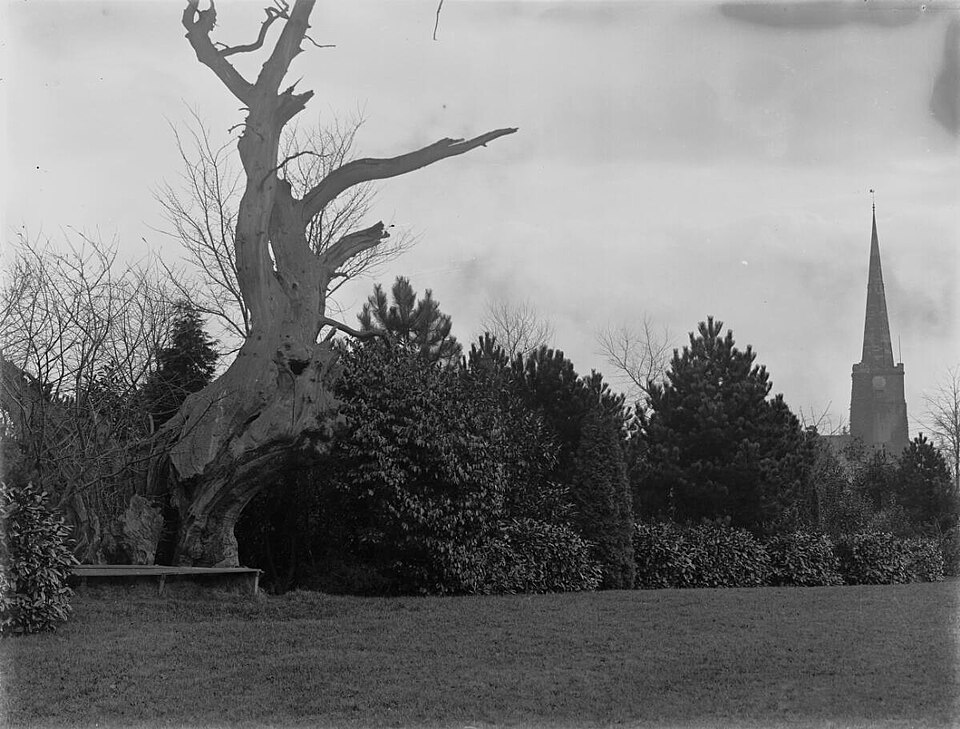
The park in 1905, thirteen years after it was handed over, with the church it was the way to still showing over the trees. Photo: Martin Ridley Collection, public domain, via Wikimedia Commons.
And a present for somebody's twenty first
The pool up the road is what turns the park from a nice anecdote into a habit.
On 2 October 1920 the pool opened, up the road from the park, given to the people of Lydney and Aylburton by the Bathurst family. It was a present for the twenty first birthday of Benjamin Ludlow Bathurst.
Benjamin was the son of Charles Bathurst junior. Who was the boy the park had been given for, in 1892, when he turned twenty five.
So the man who had been given a park as a birthday present grew up and gave the same town a swimming pool as a birthday present, for his own son, twenty eight years later. Nobody in the family appears to have considered this odd.
The early running of it was gloriously impractical. There was no filtration until 1940, so the pool was emptied every Saturday night, cleaned out, and filled again from the nearby stream on Sunday morning. Every week. All summer. Somebody's actual job.
By 1999 the council wanted rid of it, on the perfectly sensible grounds that a new indoor pool had opened nearby. The town declined. There was a lively meeting at Lydney Town Hall in the spring of 2000, the Friends of Bathurst Pool came out of it, Dai and Telma Richards took on the lease, and the place reopened after a refit in 2003.
It is still there. Thirty eight metres of open air water, run by a registered charity and staffed by volunteers, open at least fourteen weeks a summer, with solar panels on it now and artificial grass to lie on. A hundred and six years after a twenty first birthday, people are still getting in.
The gates, and the boy coming back
June 1953, for the Coronation. A man called John Watts gave the park a set of ornamental gates at the Bathurst Park Road entrance and paid to have them installed. They were handed over to Mr C H Steel, chairman of the parish council.
The gates were opened by Lord Bledisloe.
Which goes past very fast if nobody points at it. Lord Bledisloe was Charles Bathurst junior. The boy whose twenty fifth birthday had bought the park, sixty one years earlier, come back at eighty five to open a gate into it.
The man who kept giving ground away
He is owed a straight telling, because the birthday is the least of it.
Charles Bathurst was born in London on 21 September 1867, the second son. His elder brother William died in 1883, and he inherited Lydney Park in 1907. A barrister and a landowner, into Parliament in 1910, Royal Engineers in the First World War, Baron Bledisloe in 1918, a viscount in 1935.
In 1930 he went out to New Zealand as its fourth Governor-General and stayed five years. They were the worst years of the Depression, and he cut his own salary alongside the public servants whose pay was being cut, which was noticed then and is still noticed now.
Then he did the thing New Zealand actually remembers him for. The land at Waitangi where the Treaty had been signed, the founding document of the country, was in private hands. He bought it and gave it to the nation as a memorial. The dedication in 1934 drew thousands of people. He also put up a rugby trophy for matches between New Zealand and Australia, first played for in 1932, called the Bledisloe Cup, and every year an enormous number of people shout at a television about a Gloucestershire man's surname without ever knowing it.
He died at Lydney on 3 July 1958, aged ninety. He had been president of Lydney Rugby Football Club for seventy years.
The boating lake, and the absence of boats
Out near the bypass there is a lake in a place called Lakeside Gardens. It was built as a boating lake. It is signposted as a boating lake. People in the town call it the boating lake.
There are no boats on it and there have not been for years. What there is instead is the Lydney and District Angling Club, and underneath the flat brown water, carp of up to forty pounds.
A forty pound carp is roughly the weight of a five year old child. Bear that in mind next time you picture a pedalo.
It was not always so. After this article first went up, Malcolm White got in touch with the lake as he knew it in the seventies, when he paddled it himself: a cabin on the eastern side where you could hire a canoe or a rowing boat for pocket money, a rope strung across at the halfway point by the island to mark where the paddling stopped and the fishing began, and the island itself out of bounds. Whitecross School brought its pupils here to canoe as well. He offers all of it with the honest warning that fifty years have passed and his memory may not be precise, which is more care than many printed sources take. Some time in the eighties, probably, the boats stopped, and nobody seems to have written down why. If you know, the answer belongs in this paragraph, next to Malcolm's.
Down to the water
The town does not stop at the park. Head south, about a mile and a half, and the ground flattens and gets wetter and eventually gives up on being Gloucestershire at all.
Lydney Harbour is at the end of it, and the harbour is why the town got big. Coal production started around 1750. Between 1810 and 1813 the Severn and Wye Railway and Canal Company cut a canal, about a mile of it, running inland from the river, with a dock on the estuary that opened in 1813 and an outer harbour finished by 1821. A horse drawn tramroad brought coal and iron down out of the Forest to the wharves. Through the nineteenth century the place shipped coal, stone, tinplate and timber, and it kept working into the 1970s, latterly importing logs. The town's own tinplate works closed in 1957.
Walk down from the railway station rather than driving, if you can, because somebody has done something good with that path. There are three stacked sculptures along it, put in with the new information boards in 2022, built to echo the railway that used to run this way, and the sleepers have names cut into them: the ships that docked here, and the collieries that filled them.
Forest of Dean pit names are their own literature. Go on and Prosper. Never Fear. Long Looked For. Rain Proof. Speculation. Uncertainty. The Bold Defiance. Strip-and-at-it. And one called Work or Hang, which tells you everything about what a bad year underground felt like and needs no further comment from me.
The harbour, which you should actually go to
This is the bit of Lydney nobody expects, so it is the bit to plan around.
The Environment Agency runs the harbour, and it was restored over two years and reopened in July 2005, a one point nine million pound job that dredged out the silt, refurbished the stonework and swapped the old hand cranked timber gates for automated metal ones. There is a café, Hips Harbourside, open seven days, doing toasties and soup and cake. Toilets. A little visitor hub behind it with wall displays about the wildlife and the harbour's history, and information boards out around the water.
You reach the river here only at high water, which tells you most of what you need to know about this stretch of the Severn. The estuary has the second highest tidal range in the world, up to about fifteen metres. The water spends a large part of every day somewhere else.
What it leaves behind is the point. The Severn Estuary is a Site of Special Scientific Interest, a Special Area of Conservation, a Special Protection Area and a Ramsar site, which is roughly every designation the paperwork runs to, and it earns them by feeding birds. Those saltmarshes and mudflats carry an average of around seventy four thousand waterbirds every winter. Stand at the harbour wall in January and the flat brown nothing in front of you is one of the most important dinner tables in Europe.
The ships they sank on purpose
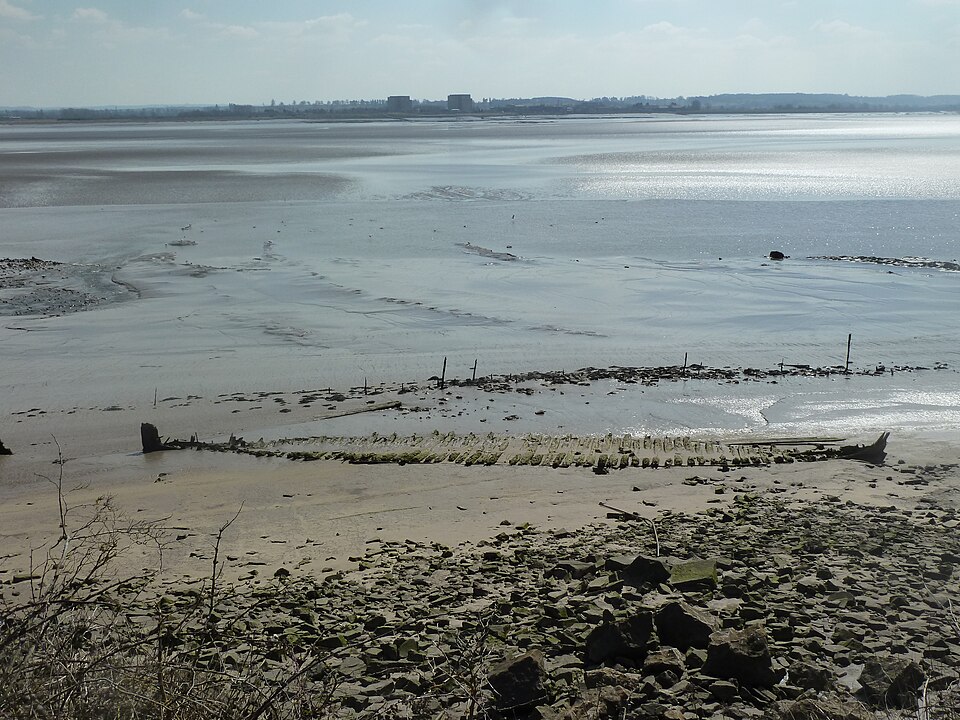
Look along the foreshore and you will see ribs coming out of the mud.
There are about twenty four of them. They are barges, and they are there because somebody put them there. The dock wall and the river bank by the canal entrance kept eroding, and the first answer was stone revetments, boulders hauled out of Forest of Dean quarries and packed against the bank to take the punch out of the water. That was the expensive answer. The cheap answer was to beach worn out boats and let their hulls do the same job, and the trouble in the early fifties was a shortage of sufficiently worn out boats.
Eventually there were enough. The harbour master, M Watson, kept workbooks between 1952 and 1955, in his own handwriting, and they say that in May 1954 barges were put into position on the river front to stop further erosion, and that in June 1954 barges were placed on the river bank. British Waterways left three or four on the foreshore to act as breakwaters, among them the Gloucester registered lighters Ripple, Llantony and the Wasp.
They are still working. Seventy years dead and still holding the bank up, which is a better afterlife than most vessels manage.
The wood that went to war
On Harbour Road, on fourteen acres beside all this, the government put up a factory in 1940 and kept quiet about it.
Pine End Works was a shadow factory, one of the plants built away from the cities so that bombing the real factory would not stop the work. It made plywood. Technical aircraft and marine plywood, to be exact, and specifically it made panels for the de Havilland Mosquito, the fighter bomber built out of wood at a point in history when everybody else had settled the question of what aeroplanes were made of, and structural parts for the Horsa assault gliders that went into Normandy on D-Day.
Stand at the end of Harbour Road and let that arrange itself. Timber came up the Severn on the tide, into a dock cut for Forest coal, and left again as the skin of an aircraft.
It carried on being quietly strange afterwards. It made a compressed, chemically treated plywood called Hydroboard, used as shielding in nuclear power stations. In the 1980s it turned out three inch plywood, surfaced with rubber and grit, for the refurbishment of Tower Bridge. Every vehicle that has crossed the Thames there since has done it on a Lydney product.
The works closed around 2001, and plans to redevelop the site fell over when lottery funding was refused. Nothing marks any of it. A town that made the Mosquito and the deck of Tower Bridge has not got so much as a plaque about it, which is either very modest or very Lydney, and possibly both.
The curse on the hill
West of the town, up on private ground, is the thing Lydney is famous for among people who have never been to Lydney.
On a wooded hill inside the Lydney Park estate there is an Iron Age promontory fort of about four and a half acres. The Romans dug into it for iron ore, probably in the third century, and gave up because it was not productive enough. Then in the late fourth century, when the empire in Britain was running out of road, somebody built a temple up there. Not the usual square Romano-Celtic plan. This one is rectangular, with three rooms partitioned inside, and it had to be rebuilt with solid walls after rockfall wrecked the original arched colonnades.
It was dedicated to Nodens, a Celtic healing god who turns up later in Irish as Nuada and in Welsh as Nudd, and as Lludd.
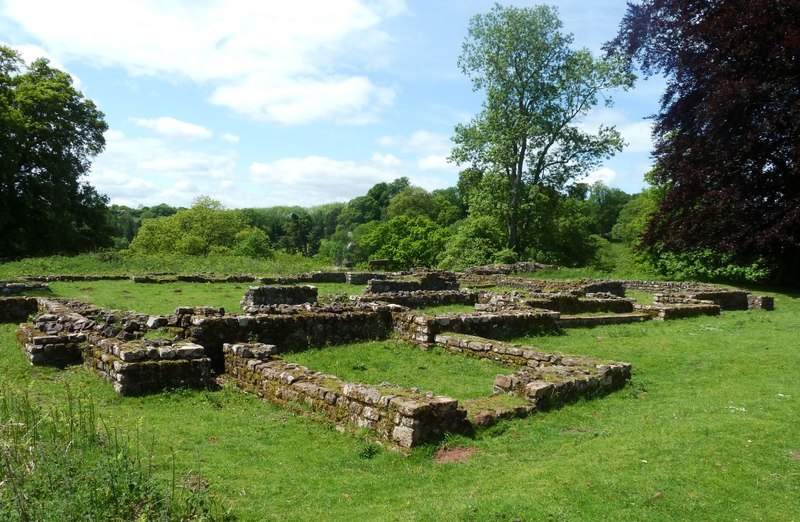
What is left of the temple, on private ground inside the Lydney Park estate. Photo: Clint Mann, CC BY-SA 2.0, via Geograph.
The town's name is tangled up in all this, and the scholars are not finished with it. The straightforward reading of the early forms, Lideneg in about 853 and Ledenei in Domesday, is "Lida's island", from an Old English personal name or the word for a sailor, plus the word for an island or river meadow. But Arthur Bernard Cook argued in 1906 for "Lludd's island", and John Koch has since suggested that the name Lida is itself a borrowing, from archaic Welsh, from the god's name, probably in the seventh century. If that is right, a healing god from a hill nobody can visit has been quietly signing the road signs for thirteen hundred years.
At some point in or before 1817, somebody found a sheet of lead at the temple, sixty four millimetres by seventy nine. It is a curse, and it is the polite procedural sort, which is somehow worse. Translated: to the god Nodens, Silvianus has lost a ring and has given half its value to Nodens. Among those who are called Senicianus, permit no health until he brings it to the temple of Nodens.
A man was robbed. Rather than go to the authorities he went to the temple, made a down payment to a god, named his suspect, and requested that the suspect's health be withheld pending return of the goods. None of this was unusual for the period. It is the paperwork of a small furious man, and it outlived him by seventeen centuries.
And a ring exists.
In 1785, seventy miles away, a plough turned up a gold ring near the Roman town of Silchester in Hampshire. Twelve grams. Twenty five millimetres across, which is to say far too big for an ordinary finger. Ten facets on the band, Venus engraved on the square bezel, and cut into it, slightly badly, the name Senicianus.
You can feel the shape people want this to have. In 1928 and 1929 Tessa and Mortimer Wheeler excavated the temple, Wheeler put the ring and the tablet side by side, and for the report he wanted the god's name explained properly, so he asked a philologist at Oxford. The philologist wrote him an appendix called "The Name 'Nodens'", published with the excavation report in 1932. The philologist was J. R. R. Tolkien.
Temple, curse, lost gold ring too large for a mortal hand, and five years later the man is writing about a hobbit. It is a wonderful story and the internet has been telling it, enthusiastically, for years.
It is also not supported by much of anything. Tolkien was asked about the name of a god. There is no record that Wheeler ever discussed the ring with him. And the link between ring and tablet, which is the hinge the whole thing swings on, was already being argued over before Tolkien was born: Haverfield came out against it, and the standard record of Romano-British inscriptions notes drily that the name Senicianus is common across the Celtic speaking provinces and a coincidence with Lydney is unlikely. The National Trust has the ring at The Vyne in Hampshire, put it on show in a 2013 exhibition, and has since gone noticeably cooler on the connection.
The true version is better anyway. A man in the fourth century lost a ring, was certain he knew who had it, and paid a god half its value to make the thief ill. That is still the most human thing on that hill.
If you go
The park is free and it is the middle of town, so start there. It has a café. The pool is a short walk away, open in summer only and staffed by volunteers, so check its own hours before turning up with a towel.
The harbour is the one to build the afternoon around. Park at the railway station and walk down past the sculptures, or drive straight to it. Café, toilets, boards, birds.
One thing to know before you set off, because if you read about Lydney Harbour online you will mostly find people cross about fencing. The north and south piers, the two arms that run out into the Severn, were closed off in 2023 on safety grounds and they are still closed. The temporary green mesh has gone and proper fencing has replaced it, which is an improvement to look at and not a change of mind. You cannot walk the piers.
Everything else you can. The harbour, the basin, the canal, the paths round the water, the café, the boards. That is the visit, and it is a good one. The piers are the bit you look at rather than the bit you stand on, which is not what the town wanted and is worth knowing before you drive down expecting otherwise.
One plain note, and this one is not a joke: the mud out there is tidal, deep and not a surface. Look at it from the wall.
The Roman temple is on private land and Lydney Park is a working estate. The gardens open in spring, roughly April to June, when the magnolias and rhododendrons are what most people come for, and the museum that holds the curse tablet opens on Sundays and bank holiday Mondays in that season. There is an admission charge. It is a separate trip up a different road and it runs on somebody else's calendar rather than yours, so check the estate's own days before setting out.
One more, on the way in or out. Taurus Crafts, at the Old Park, is a set of seventeenth century courtyards holding workshops, a zero waste shop and a café, run by the Camphill Village Trust as a working campus for adults with learning disabilities and autism. The coffee has something underneath it. The Christmas market is a local institution.
If you are staying in the Wye Valley
Twenty minutes away, and worth the drive precisely because it is not what you came for.
Chepstow, Tintern and the cliff walks are the postcard and they know it. Lydney is the working end of the same landscape: the town the coal came down to, the dock it left from, the flat brown estuary all that scenery has been draining into the whole time. Three days of watching a river be beautiful in a gorge, and then you go and see where it ends up.
A note on this one
The spine came from the Forest of Dean Local History Society's page on the park and from the pool's own history page, written by the volunteers who run it. Between them they turned what looked like one nice story into a pattern: two birthday presents, twenty eight years apart, the second given by the boy from the first.
That local page also nearly caught us out. It says the park gained its bandstand and pitches over "the past 121 years", which dates the sentence to about 2013. From 1892 it is a hundred and thirty four years in 2026. Numbers in a source are true on the day somebody wrote them and not one day after.
The boating lake's boats came back to this page because Malcolm White, who paddled here as a boy, got in touch with the seventies picture: the hire cabin, the rope, the school canoeing. He is careful about what fifty years does to a memory, and the article keeps his caution printed next to his facts. If his paragraph jogs anything loose in anyone else, this page is happy to keep growing. Updated 10 August 2026 to carry it.
The hulks are dated by an ordinary man's handwriting. M Watson kept the harbour master's workbooks from 1952 to 1955 and wrote down, in May and June 1954, that barges had been put on the river front and the bank. That is why this article can say 1954 rather than "the fifties". Somebody kept the dull books, and seventy years on the dull books are the only reason anyone knows.
The ring is the other thing worth flagging, because it is why a lot of people arrive in Lydney at all. Nearly every telling of it online asserts the Tolkien connection flatly. Half an hour with the actual inscription record and the National Trust's own catalogue entry turns it into something better: a real fourth century theft, a genuine appendix by Tolkien about a god's name, and a link between the two that scholars have been quietly declining to accept since the nineteenth century. If you read one source at the foot of this page, make it RIB 306. Four lines of furious Latin, and it has outlasted everybody involved.
everything above is checked. if we could not find a source for something, it is not in here.
- Forest of Dean Local History Society: Bathurst Park, Lydney
- Bathurst Pool: the history of the open air pool, written by the people who run it
- Charles Bathurst, 1st Viscount Bledisloe (Wikipedia): the second son, New Zealand, Waitangi and the cup
- Friends of Purton: the Lydney hulks, and the harbour master's workbooks that date them
- Forest of Dean District Council: visiting Lydney Harbour, the café, the boards and the sculptures
- Environment Agency: Lydney Harbour, the guidance page for the harbour it runs
- Forest of Dean Local History Society: Pine End Works, Lydney
- Forest of Dean Local History Society: Strip-and-at-it Colliery, and how the Forest named its pits
- RIB 306, the curse upon Senicianus: the Latin, the translation and the find date
- Ring of Silvianus (Wikipedia): the Silchester find, and how thin the Tolkien link actually is
- Ring of Senicianus, National Trust Collections, The Vyne
- Lydney Park (Wikipedia): the temple, the hillfort, the Wheeler excavation and Tolkien's appendix
- Nodens (Wikipedia): the god, and the argument about where the town's name comes from
- Lydney Park Estate: the gardens, the museums and when they open
- Camphill Village Trust: Taurus Crafts at the Old Park
- JNCC Ramsar Information Sheet: Severn Estuary