Eclipse night, 12 August 2026: a 93 percent eclipse at sunset, and why you need to get out of the trees
On Wednesday evening the Moon covers around 93 percent of the Sun over the Forest of Dean and Wye Valley, the deepest eclipse seen from this part of Britain since 1999. The same night, the Perseids peak under a moonless sky. The one enemy is the tree at the end of the car park. Where to go west of the Severn, and how to look without hurting your eyes.
whimsee field notes · Forest of Dean and the lower Wye Valley · 6 August 2026
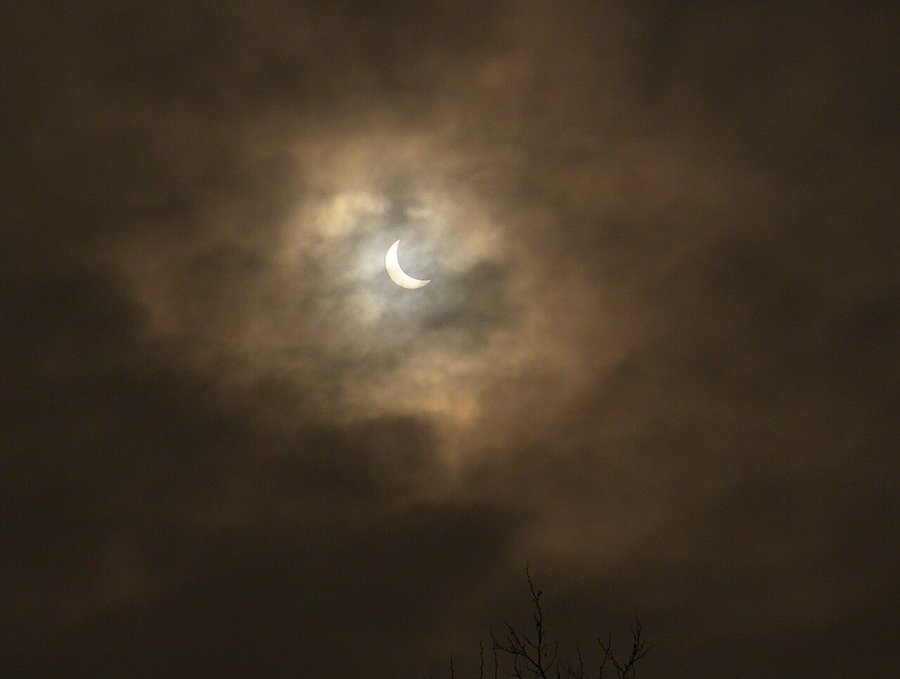
Wednesday, 12 August. The Moon crosses the Sun while the Sun is on its way down over Wales, and from the Forest of Dean and the lower Wye about 93 percent of it goes missing.
That is the deepest eclipse this corner of Britain has had since August 1999, and there is nothing to match it from here until 2081. The next total eclipse over British ground is in 2090. So: Wednesday, or your grandchildren.
It won't go dark. That is the thing everybody expects and it isn't what happens. Seven percent of the Sun is still a preposterous quantity of Sun. What you get instead is stranger and better. From about 80 percent covered the daylight starts to drain away, and by maximum the evening has gone thin and metallic, like heavy overcast with the contrast pushed up, and the temperature eases off. Shadows go oddly sharp. And under any leafy tree the ground fills up with little crescents, hundreds of them, because every gap between the leaves is working as a pinhole camera and throwing a copy of the half-eaten Sun down onto the path.
The times, for this corner of the map: 18:16, 19:13, 20:06
All British Summer Time, worked for the Forest and the lower Wye. Places further west run a minute or two behind.
First bite at about 18:16, Sun 21 degrees up, due west. Maximum about 19:13, Sun down to 12 degrees, west-northwest. Last contact about 20:06, Sun at 4 degrees, three quarters of an hour short of setting.
Two hours, then, all of it low in the west, with the Sun dropping 17 degrees and sliding right the whole time. You need a clean line out that way, and you need it to stay clean for the duration.
The tree at the end of the car park
Everyone worries about the wrong thing. The instinct is to look at the horizon and fret about the Black Mountains, the Welsh ridges stacking up in the west. They are not the problem. At maximum the Sun is 12 degrees up and clears the Beacons from here with a comfortable margin.
The oak at the end of the car park is a different matter. At 12 degrees, a 20 metre tree has to be standing more than about 95 metres away to be out of your line. By last contact, with the Sun down at 4 degrees, that same tree needs nearly 300 metres. There is almost nowhere inside the Forest of Dean that can offer you that to the west.
So, awkwardly for a Forest blog: on Wednesday evening, get out of the trees. A woodland car park with a wall of conifers along its western side is the precise wrong answer. What you want is open moor, an escarpment edge, or water.
Where to go: five sites west of the Severn
Keeper's Pond, on the Blorenge is the best answer within an hour of the Forest. Open moorland at about 490 metres on the mountain road between Abergavenny and Blaenavon, free parking right beside the water, and nothing west of you but moor falling away towards the Usk. If the wind gets up you can watch the whole two hours from the driver's seat. The road is narrow in places and the ponies own it after dark, so take the drive home slowly.
Hay Bluff, at Gospel Pass gives you nothing extra for the eclipse itself. It earns its place for later, because it sits inside the Bannau Brycheiniog Dark Sky Reserve, and that matters enormously once the light has gone. The pass road is single track with steep drops and it will be busy on the night. If anybody in the car dislikes that sort of road, believe them, and come up the gentler way from Hay-on-Wye instead.
The coast, if Tuesday's forecast is kind. Rest Bay at Porthcawl faces west off a big car park onto a sea horizon, which is the one thing no inland site can give you: open water all the way down to zero degrees, nothing standing in it, no guesswork about what might be hiding behind what. One catch. The car park has been reported as closing at 20:00, six minutes before last contact, which would be a memorable way to miss the end of it, so ring Bridgend council before you trust the evening to it. Rhossili, further out on Gower, faces the open Atlantic and gives you the deepest and longest version of Wednesday available anywhere within reach. It also costs the longest drive and gets first claim on any Atlantic cloud.
Choosing, honestly: clear forecast, drive west and take the sea. Marginal forecast, stay inland and stay short, so you can still change your mind at six o'clock. Either way, check the cloud out over the Bristol Channel rather than the cloud over your own house, because at 12 degrees you are looking through a hundred miles of atmosphere. A weather app's little sun icon knows nothing about that.
One thing worth doing on Tuesday. At about 19:15 the Sun stands within a degree of where it will be at Wednesday's maximum. Go to your chosen spot, look west, and if you can see the Sun from where you would park, the site works. If you are looking at a tree, you have a whole day to find somewhere else.
How to look at it safely. No jokes in this bit
There is no safe moment to look at this one with a naked eye. Not at maximum, and not at the end when the Sun is low and red and looks harmless. Low Sun feels gentle and does exactly the same damage, and at 93 percent covered that last sliver is still thousands of times too bright for a retina, which has no pain nerves and gives no warning whatsoever.
Eclipse glasses, ISO 12312-2, on for the entire two hours, bought from an astronomy supplier rather than whatever a marketplace listing is selling this week. Check every pair against a bright light for scratches and pinholes before anyone puts them on. Sunglasses don't work. Several pairs of sunglasses stacked up don't work either.
The one that catches people out: never look through a camera, phone, binoculars or telescope while wearing eclipse glasses. The optics gather the light and burn straight through the filter. A camera wants a proper solar filter over the front of the lens.
If you would rather not buy anything, project it instead. A hole in a piece of card, the Sun's image thrown onto a second piece held a little way off. A kitchen colander does the whole job at once and scatters a constellation of crescents. And the trees, hopeless as viewpoints, come good here: stand under any leafy branch and the path beneath it fills with projected crescents. Safe to look at, safe to photograph, and probably the best picture most people will get all evening.
Then stay out, because the Perseids peak the same night
A solar eclipse can only happen at new Moon. Which means the night following Wednesday's eclipse has no Moon in it at all, and that night happens to be the peak of the Perseids. Most Augusts the Perseids spend the night arguing with moonlight and losing. Not this one.
From about 22:15 the first ones turn up as the blue drains out of the sky. Properly dark by 23:00, and the rates climb through the small hours as the radiant in Perseus lifts higher in the northeast. Under a genuinely dark sky the shower can manage 100 an hour or more near the peak. You will see fewer than that. Everybody always does, because the figure assumes perfect conditions and a radiant overhead, and you will come home happy anyway, because Perseids run fast and bright and leave a trail hanging in the dark for a second after they have gone.
No equipment. And definitely not the eclipse glasses, which are for the Sun and for nothing else in the sky. Don't stare at Perseus either; the meteors turn up all over, so lie back and take in as much of it as you can manage. Twenty minutes for your eyes to adapt, then guard the adaptation, because one person checking a phone resets everybody near them. Red torch good. White torch catastrophic. It gets genuinely cold on a Welsh hillside at one in the morning in August, so bring more layers than feels reasonable, and something to lie on.
If the meteors are the half you actually care about, Hay Bluff does both ends of the night, being inside the Dark Sky Reserve, with Keeper's Pond a close second on the edge of the same park. The coast sites pay for that sea horizon in streetlight, and in a two-in-the-morning drive home.
For anyone going the full distance, there is a line of planets low in the east before Thursday's dawn. Mercury, Jupiter, Mars and Saturn to the naked eye, with Uranus and Neptune in the same stretch of sky for anyone carrying binoculars, in a narrow window before the light comes back.
If you go
Decide on Tuesday evening, once the cloud forecast firms up. Be parked by 18:00, because everyone else has had the same idea and they are all arriving for maximum. Nothing at any of these sites is flat, lit or furnished, so folding chairs earn their space in the boot, and there is nowhere to buy so much as a coffee once the light goes. Set a map pin on the actual car park rather than the village name; satnavs route to village centres, and you can end up in Blaenavon looking up at a hill you have no obvious way onto.
Eclipse glasses for every person. Checked in daylight, before you leave the house.
And if Wednesday clouds over, which in Wales in August it well might: the light still does its draining trick behind the grey, the temperature still drops, and the Perseids run either side of the peak anyway. Go out regardless. Most of Cornwall was under cloud for the 1999 totality, and the people who stood in it have not stopped talking about it since.
A note on this one
The times and angles were worked for this corner of Gloucestershire and then checked against the published circumstances for Cardiff, which run about a minute ahead of the figures above. The Royal Astronomical Society and Royal Observatory Greenwich pages carry the national picture.
Worth knowing about that 93 percent, because it is the number most likely to be argued with. It is obscuration, meaning the fraction of the Sun's face covered, and it is the figure that matches what your eyes actually experience. Plenty of pages quote magnitude instead, which measures something slightly different and comes out higher, and the two get mixed up constantly.
The tree arithmetic is ordinary trigonometry, and it is why this article keeps going on about car parks. One claim got softened during checking: the widely repeated line about the path of totality crossing Iceland turns out to mean the far western tip of it, which matters a great deal to anybody standing in Reykjavik on Wednesday with the wrong expectations.
- What time is the solar eclipse on 12 August 2026 in the Forest of Dean and Wye Valley?
- The partial eclipse begins at about 18:16 BST, reaches maximum at about 19:13 BST and ends at about 20:06 BST. Sunset follows around 20:37. Places further west run a minute or two later.
- How much of the Sun will be covered from Gloucestershire and south Wales?
- About 93 percent of the Sun's face is covered at maximum, measured as obscuration. It is the deepest eclipse seen from this part of Britain since August 1999, but it is not totality, so the sky will not go properly dark.
- Is it safe to look at the eclipse without eclipse glasses?
- No. There is no safe moment during a partial eclipse, including at the end when the Sun sits low and red. Use eclipse glasses certified to ISO 12312-2 for the entire two hours, or project the Sun through a pinhole onto card. Never look through a camera, phone, binoculars or telescope while wearing eclipse glasses, because the optics burn straight through the filter.
- Where is the best place to watch the eclipse near the Forest of Dean?
- Somewhere with an open western horizon, which rules out most of the Forest itself. Keeper's Pond on the Blorenge is the best site within an hour, at about 490 metres with open moor to the west. Hay Bluff at Gospel Pass is the choice if you are staying for the Perseids, being inside the Bannau Brycheiniog Dark Sky Reserve. Rest Bay at Porthcawl gives a true sea horizon.
- Why do trees matter more than mountains for watching this eclipse?
- Because the Sun is low. At maximum it sits 12 degrees above the horizon and clears the Welsh hills comfortably, but a 20 metre tree must stand more than about 95 metres away to be out of the line of sight, and nearly 300 metres away by the end of the eclipse. A woodland car park with conifers along its western edge will block the whole event.
- Can you see the Perseid meteor shower on the same night?
- Yes, and 2026 is an exceptional year for it. A solar eclipse can only happen at new Moon, so the night of 12 to 13 August is completely moonless. First meteors appear around 22:15, full dark comes about 23:00, and rates climb through the small hours as the radiant in Perseus rises in the northeast.
everything above is checked. if we could not find a source for something, it is not in here.
- Royal Observatory Greenwich: the 12 August 2026 partial solar eclipse from the UK
- Royal Astronomical Society: the best solar eclipse visible from the UK since 1999
- BBC Sky at Night: the August 2026 eclipse from the UK and Ireland, place by place
- timeanddate.com: local circumstances for Cardiff, 12 August 2026
- Royal Observatory Greenwich: the Perseid meteor shower, when and how to watch
- American Astronomical Society: eye safety during solar eclipses
- UK Health Security Agency: how to watch the solar eclipse safely this summer
whimsee is a little app for wandering. people leave small glimmers of wonder in places like this one, and other people go and find them. no feed, no algorithm, just a reason to go outside.
see how it works