Soudley: the valley where the Forest keeps its memory, and its voice
Four ponds nobody can quite explain, a museum built out of fear in an old mill, and the last strongholds of Forest of Dean dialect: ow bist, old butty. A walk down the Soudley valley, into the Dean Heritage Centre, and up to the Forest's one great window on the Severn.
whimsee field notes · Dean Heritage Centre · 1 August 2026
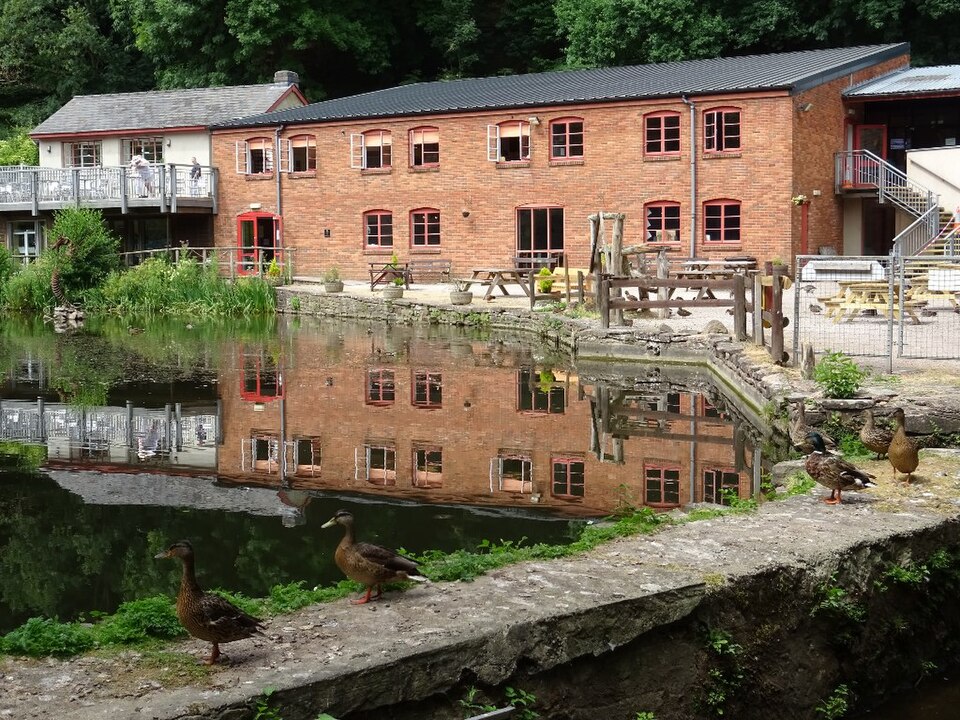
There are two kinds of place in the Forest of Dean. There are the places that got famous, which cluster along the Wye and photograph well from above. And there are the places the Forest actually happened: the working valleys in the middle, where the coal and the iron and the words came from. Soudley is the second kind, and it is where the Forest has chosen to keep its memory.
It is a small village in a wooded valley south of Cinderford, with a brook running through it, a pub with a skittle alley, and once a year a duck race on the brook, using plastic ducks, accompanied by a fair. The pub holds snail races. This is a valley that has measured out exactly how much excitement it needs, and it is not an accident that when the Forest needed somewhere to keep its past, it chose here.
The ponds nobody will explain
Start at the top of the valley, at Soudley Ponds: four linked ponds in a line under a stand of Douglas firs tall enough to change the acoustics, now a Site of Special Scientific Interest, which is officialdom's way of saying something lives here that lives almost nowhere else, tread gently.
The ponds are man-made. That is where certainty ends. The record says they were dug for recreational fishing in the nineteenth century. The locals have always called them the hammer ponds, which is not a fishing word, and the woods around them are called Foundry Wood, Abbots Wood and Wellsprings Wood, which is the landscape quietly filing its own evidence. Fast water, a foundry, and ponds to hold the head of it: the names remember an iron valley even if the paperwork remembers a fishing one.
Either way, the walk along them is the gentlest half hour in the central Forest, and the lower pond still works for a living: a fly fishing syndicate leases it, so leave the swims to the people standing in them.
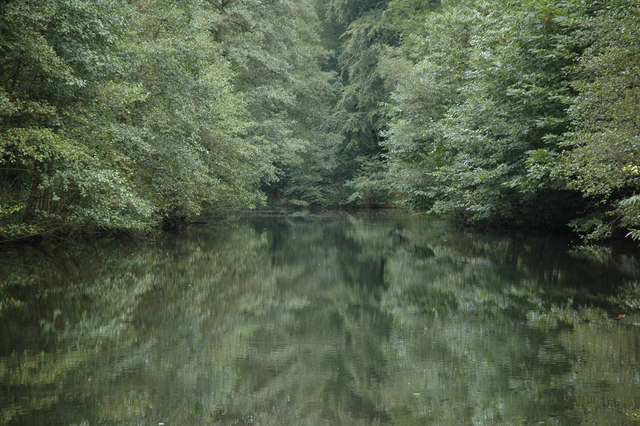
One of the hammer ponds doing what it does now, which is nothing, beautifully. Photo: Philip Halling, CC BY-SA 2.0, via Geograph.
The mill that became a memory
Halfway down the valley the brook arrives at Camp Mill, and Camp Mill is the reason to come.
In 1979 people in the Forest became frightened, in an organised way, that the place's heritage was fading faster than anyone was recording it. The men who had worked the pits were going; the words were going with them. So they formed a charity, the Dean Heritage Museum Trust, took on the old mill site at Camp Mill in 1981, and with local donations opened a museum in 1983. The Heritage Lottery Fund paid for a major refit finished in 2003. Fear, it turns out, is a fine architect. The museum a valley builds when it is worried about forgetting is better than the museum a committee builds when it is feeling confident.
They could not have chosen a better building, because Camp Mill had already been everything. The site has run on the brook's water for four centuries. An iron forge is believed to have worked here between 1612 and 1674, in the years when James I was ordering forges built across the Forest. In 1823 Samuel Hewlett set up an iron foundry on the site. In 1876 the foundry buildings became a corn mill, worked by a Cinderford man named Edmund Lane. In 1888 John Mason leased it and turned it to making leather board, pressed fibre for the inner soles and heel stiffeners of boots. In the twentieth century it was a saw mill, and by the 1960s a scrap yard.
Forge, foundry, corn, leather, timber, scrap, memory. The building that keeps the Forest's history has personally been most of the Forest's economy, and its final trade is remembering the previous six.
Today the Dean Heritage Centre runs five galleries that take the Forest from prehistory to the Second World War, with a reconstructed forester's cottage and a replica free mine in the grounds. The free mine matters: freemining is the Forest's peculiar ancient right, by which a Forester with the right birth and a year and a day of work underground can be granted their own small mine, or gale, and a handful of freeminers work their gales to this day. Other museums show you coal mining. This one shows you a legal system with a pickaxe.
The room where the Forest talks
The reason this article exists is a set of exhibition panels the Centre put up with Reading the Forest, a University of Gloucestershire project that has spent years researching the Forest's writers, and with the Forest of Dean Writers Collection, which between 2023 and 2026 gathered two centuries of Forest authors' papers into the Centre's archive.
The panels are about Forest dialect writing, and they are the best room in the Forest, because they are the sound of the place pinned to a wall.
Forest dialect is its own thing: thee and thou still working for a living, f softening to v so the Forest becomes the Vorest, and a vocabulary the coal industry left behind. The great one is butty, the Forest's word for friend, from the men who worked the pits in pairs. Your butty was the one who went underground with you. The dialect greeting, ow bist, old butty, translates as how are you, my friend, and does not really translate at all.
The panels let the writers do the talking. Keith Morgan, who still performs his poems in dialect, supplies a Varest national anthem: "Fer the Varest's 'eaven on earth, every mon da know it's wuth." Harry Beddington of Cinderford wrote poems, plays and entire books in dialect, and the panel's best exhibit is a fan's letter to him from 1961: "Thee'st done a good job, auld 'un. 'Thunt everybody as can write good Vorest!" It is not everybody who can write good Forest. F. W. Harvey, the Gloucestershire poet, put Forest speech on the wireless in his 1930s radio series about his friends the Foresters. Winifred Foley, born in 1914 in the mining village of Brierley over the hill, went out first on the air: A Child in the Forest was a Woman's Hour radio serial in 1973 before it became a book in 1974, so the Forest's voice was broadcast before it was printed. On the page she used dialect the way a fire uses coal: "our Mam'll be making thy eyes pop out o' thy yud." Humphrey Phelps simply wrote down what he overheard, which is how we have a Forest gardener reporting on his weeds: "they be all growed up an' 'ad young 'uns."
And there is a warning from history on the wall too. The Reverend H. G. Nicholls, writing in 1868, thought it would be a good thing if Forest dialect disappeared. Then he transcribed a conversation in it at the end of his book, carefully, so that we still have it. Even the man who wanted it gone could not stop himself keeping it.
The country boy
The Centre also holds the archive of the Forest's most famous writer. Dennis Potter, who grew up at Berry Hill, became one of the great television dramatists: Pennies from Heaven, Blue Remembered Hills, The Singing Detective. The archive, opened to the public in 2013, holds his drafts, typescripts and production notes, the working papers of a man who took a Forest childhood and made television art out of it for thirty years.
His first book about home was not drama at all. The Changing Forest (1962), written in his twenties, is reportage, and its question is the exact fear this museum was later built on: whether the Forest's own culture could survive television, the very medium Potter was about to master. Seventeen years after he asked, the valley answered him by founding the trust that built this place.
One line of his belongs with the dialect panels rather than the drama. In 1993, near the end of his life, he said that whenever he wished to be tender with his children, he would say thee and thou, as his father did to him. That is what a dialect is, underneath the spelling: the register a place keeps for love.
The woman from this valley
One of the writers in the Collection grew up right here in Soudley, and she is owed a straight telling.
Valerie Grosvenor Myer, 1935 to 2007, went from this valley to a job on the Dean Forest Mercury, and from there, as a mature student, to Newnham College, Cambridge. She became a journalist, an academic, a literary biographer, a novelist, and a specialist on the life and work of Jane Austen, and she taught and lectured around the world. In 1989 she was in China when the Tiananmen Square massacre happened, and her letter describing her escape is in the Collection, along with her scrapbooks, her photographs, an unpublished novel, and a 1960s portrait of herself and her husband Michael.
A childhood in a Forest mining valley, and a life spent as one of the world's readers of Austen. The distance between those two sentences is the whole point of keeping an archive.
Always about to disappear
The room holds one strange comfort. Scholars started writing Forest dialect down at the end of the eighteenth century because they feared it was about to vanish. That was more than two hundred years ago. It has been about to vanish ever since, and it is still here: thinner, older, but present, in the mouths of people buying stamps and in the pages the Collection keeps.
Some things survive by being too useful to drop. There is no standard English replacement for butty, because standard English never had to send two people down a mine together.
The window on the Severn
Do not leave the valley without going up. From near the Centre, forest tracks climb east to Blaize Bailey, and at the top the Forest, which spends most of its time being an interior, suddenly opens its one great window: the Severn below you in its huge horseshoe bend at Newnham, silver or pewter depending on the day's mood, with England going on behind it.
The viewpoint itself is built from the stones of a dismantled railway bridge from Fetter Hill, which is very Forest of Dean: nothing wasted, everything reused, even the view furniture.
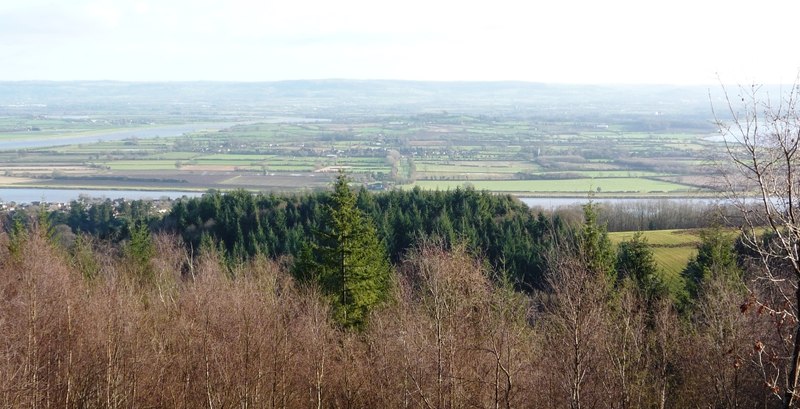
The window, open. The Severn in its horseshoe bend below Newnham, from Blaize Bailey in winter. Photo: Clint Mann, CC BY-SA 2.0, via Geograph.
It is a proper walk up rather than a stroll, and worth every step of it. The writers on the wall down in the valley grew up inside a forest that only occasionally shows you where you are. This is where it does.
The road that will not give its age
One more thing hides in this valley, down the road at Blackpool Bridge, and it is the oldest argument in the parish. Beside the modern lane a stretch of ancient paved road comes to the surface: small stone blocks set between neat kerbstones, unmistakably engineered, part of the old Dean Road that climbed up through the Forest from Lydney. It is a scheduled monument, and it has been called Roman for as long as anyone has written about it.
Called, note. In 1985 charcoal from beneath the stones was radiocarbon dated and came back seventeenth century at the earliest, which caused exactly the upset you would imagine. The sample was later shown to be unreliable, which un-caused it.
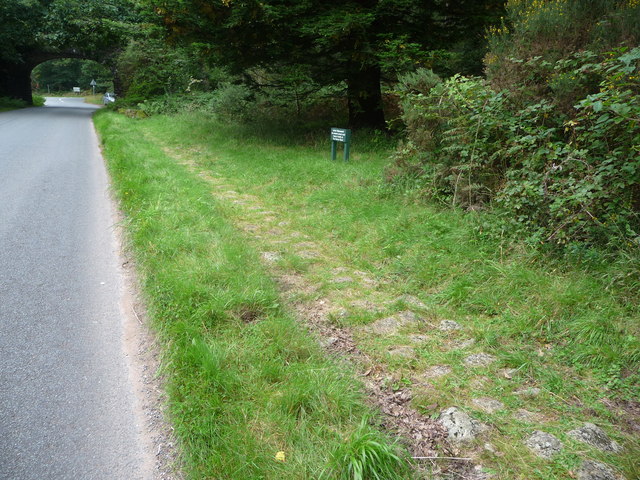
The Dean Road surfacing through the grass beside the lane at Blackpool Bridge, with the old railway arch beyond. Photo: Jeremy Bolwell, CC BY-SA 2.0, via Geograph. So the honest position is a kerbed and cobbled road of disputed age, either seventeen hundred years old or four hundred, beautifully made either way. The Forest has settled the matter in its own fashion, by calling it simply the Dean Road and leaving the centuries to argue among themselves.
If you go
Soudley is ten minutes from Cinderford and about fifteen from Lydney, down a wooded valley road. The Dean Heritage Centre is at Camp Mill: check its own site for current opening days and prices before you set out, and give it longer than you think, because the galleries, the cottage and the mine grounds add up. The ponds are a short way up the valley with their own parking, and the pond path is level and gentle.
Two plain notes, and these are not jokes. The ponds are deep water with unfenced banks, so stay on the made paths. And the valley road is narrow with no pavement in stretches, so walk it with your ears on; the same goes for the Dean Road stones at Blackpool Bridge, which sit beside a live lane and are for looking at from the verge.
Phone signal in the valley bottom is not to be relied on. Sort your maps before you arrive.
If you are staying in the Wye Valley
You are twenty five minutes away, and this is the other half of the story you have been looking at. The Wye side is the Forest's beautiful face, the one Wordsworth wrote about. Soudley is its working heart: the valley kind of country the coal and iron came out of, and the museum where all of it ended up being kept. Do the gorge in the morning, this valley in the afternoon, and by evening you will have met both of the Forests, the one that got painted and the one that did the work.
A note on this one
This article came out of an afternoon at the Dean Heritage Centre's Forest writers exhibition, and most of the dialect material on this page is quoted from its panels, which were produced with Reading the Forest, the University of Gloucestershire and the Dean Heritage Centre, supported by the Heritage Fund. The panels gloss every dialect quotation into plain English at the foot, which this article has borrowed as a courtesy, and which is worth saying out loud: an exhibition that trusts you with the real spelling and then quietly helps you is doing accessibility properly.
The writers quoted are named where they are quoted, and the one thing this article wants checked against its sources is the thing that cannot be: the sound. Forest dialect on a page is a transcript. The 1980s recordings the panels mention, Forest Talk and A 'Quat 'an a Chat, captured the writers reading their own work, and they are the true source this page is a shadow of.
The building's own biography, forge to foundry to corn to leather to museum, comes from the Centre's own telling of Camp Mill's history. And the one number in this article that refused to settle is an age: the Dean Road's 1985 radiocarbon date said seventeenth century, and was then itself found unreliable. An article can hold an open question honestly. Pretending it is closed is the only wrong answer.
other places nearby somebody has already marked in the app.
everything above is checked. if we could not find a source for something, it is not in here.
- Dean Heritage Centre: about the charity, the mill and the museum
- Dean Heritage Centre, Wikipedia: the 1979 trust, Camp Mill and the 1983 opening
- Forest of Dean Writers Collection at the Dean Heritage Centre
- The Dennis Potter Archive at the Dean Heritage Centre
- Reading the Forest: the University of Gloucestershire project on the Forest's literary heritage
- Jason Griffiths, Reading the Forest: a history and analysis of Forest of Dean literature (PhD thesis, University of Gloucestershire, 2019)
- Forestry England: Soudley Ponds
- A walk by Soudley Ponds: the hammer ponds mystery, told by a local walker
- Soudley, Wikipedia: the village, the brook, the duck race
- Winifred Foley, Wikipedia: A Child in the Forest
- Forest of Dean Heritage Open Days: Camp Mill's four centuries, forge to museum
- Graces Guide: Samuel Hewlett and the 1823 foundry at Camp Mill
- Historic England: the section of Roman road at Blackpool Bridge, the scheduling
- Forest of Dean Local History Society: the Dean Road, and the argument about its age
- Great British Life: Dennis Potter, the Forest born writer, and The Changing Forest
whimsee is a little app for wandering. people leave small glimmers of wonder in places like this one, and other people go and find them. no feed, no algorithm, just a reason to go outside.
see how it works