St Briavels: the castle that armed a kingdom, and the village that pays its rent in cheese
A quiet village on a ridge above the Wye was once the capital of the Forest of Dean and the crossbow bolt factory of medieval England. Its castle is now a youth hostel, its miners' rights still turn on where you were born, and every Whit Sunday bread and cheese is thrown to the crowd, as it has been since at least 1779.
whimsee field notes · St Briavels Castle · 1 August 2026
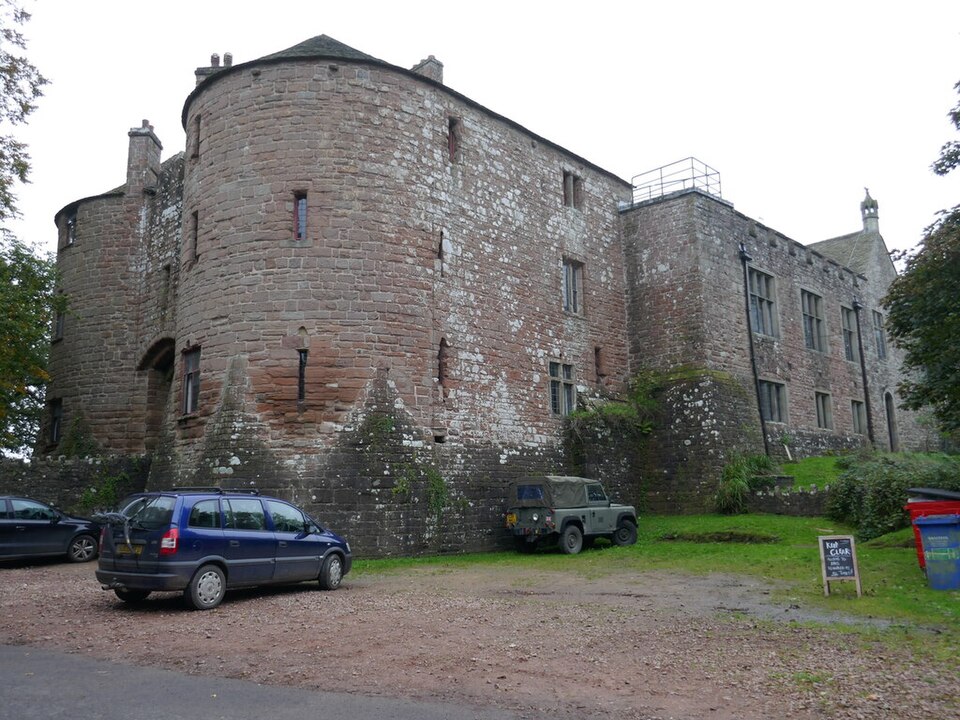
St Briavels looks like a village that has never done anything. A ridge above the Wye, a church, a pub, a green, lanes that were not designed for your car and do not intend to apologise. It photographs as pure ornament.
It was the capital. For centuries this village ran the Forest of Dean: its castle held the Forest's court, its constable held the Forest's keys, and the administrative district that still governs who may mine the Forest carries its name to this day. And for a stretch of the thirteenth century, this quiet ridge was where England made its ammunition.
The castle opposite the church
The castle and the church stand face to face across the lane, which is the whole medieval settlement summarised in one glance: the house of God and the house of the king's business, Norman both, keeping an eye on each other across ten metres of Gloucestershire for the better part of nine centuries.
The castle went up between 1075 and 1129, not as a fortress against anyone in particular but as an office: the royal administrative centre for the Forest of Dean, which was a resource before it was a landscape. Deer for the king's table, timber for the king's ships, iron for the king's wars. King John, who took his hunting seriously, used it as a favourite lodge, and the great gatehouse that fronts the village green today was added by Edward I, a pair of drum towers now overlooking a moat that has retired into gardens.
The village that made the arrows
A crossbow, in the thirteenth century, was the serious weapon of the age, and crossbows were made at the Tower of London. But a crossbow without bolts is a stick with ambitions, and the bolts, called quarrels, needed iron, charcoal and fletching in industrial quantities. The Forest of Dean had all three. So the crown put its quarrel works here, inside the castle, and from 1228 the king's quarrel maker ran his forge in this village.
His name was John Malemort, which translates roughly as bad death. There are jobs where the name is the qualification.
The numbers survive. By 1233 the St Briavels works could turn out one hundred and twenty thousand quarrels in a hundred and twenty days: a thousand bolts a day, every day, out of Forest iron smelted with Forest charcoal, from a village you can walk across in four minutes. When the king's armies fought in Wales and France, a measurable fraction of what they shot began as ore under the trees a few miles from this green.
The Hundred, and the miners it still makes
The district the castle governed is called the Hundred of St Briavels, and the Hundred is what separates this village from every other pretty ridge in England, because it is not history. It is a live legal boundary, and it still decides who may mine the Forest of Dean.
The rule was written down in the Dean Forest (Mines) Act of 1838, codifying rights the miners swore were older than any parchment: a person born and abiding within the Hundred of St Briavels, aged twenty one or more, who has worked a year and a day in a mine within the Hundred, is a freeminer, and may be granted their own small mine, called a gale. The Act said "all male persons"; since 2010 the register takes women too, the Gaveller having sensibly concluded that the nineteenth century did not get the last word. There are freeminers working their gales in the Forest now, this year, under those exact terms.
Which means being born inside the boundary of this village's old jurisdiction still confers a mineral right that being born one field outside it does not. The castle stopped collecting the Forest's dues long ago. The map it drew is still deciding things.
The prison years
Like most buildings that outlive their first job, the castle fell into its second one by gravity: it became a court, and then a debtors' prison, and at that it was notorious. The prison reformer John Howard came in 1775, in his methodical way, and recorded conditions plainly bad even by the standards of a century that took bad prisons for granted. Debtors scratched their names and their dates into the walls, and the graffiti is still there: the signatures of people whose whole crime was owing money, cut into the same building where the king once stockpiled a thousand deaths a day.
It took riots and a parliamentary investigation in the 1830s to end it, and the castle's long public career wound down into a courthouse, then a school, then silence.
In which the arsenal becomes a bunkhouse
And then, in 1948, the Youth Hostels Association moved in, and it has been a hostel ever since. King John's hunting lodge, the crown's ammunition works, one of the grimmer debtors' prisons in the west of England: bunk beds. You can book a night. Ghost hunters bill it as one of the most haunted castles in England, and the hostel does a brisk trade in medieval banquets and creaking floors, and every so often somebody wakes at three in the morning quite certain of a presence, in a building where the recorded suffering required no supernatural assistance at all.
It might be the gentlest retirement any arsenal has ever been given. It is certainly the cheapest night anyone spends in a scheduled monument with eight hundred years of paperwork.
Across the lane
The church has been the castle's neighbour for so long that most tellings treat it as scenery. It is worth a section of its own. The first stone church went up around 1086, the building grew into its cruciform shape through the twelfth century, and it has served this ridge for very nearly a thousand years. It is open most days, which the castle is not.
Inside, two oddities and a Liverpool story. The Norman font wears a carved stone skirt around its base, scalloped into what one guide describes, accurately, as a child's drawing of a daisy. Nobody knows what the skirt is for, and it is believed to be unique in Britain: one font, one daisy, this village. The tower carries eight bells, the largest over half a ton, which is a great deal of bronze for a place this size.
The organ is the Liverpool story. Robert Ernest Bryson made his living as a cotton merchant in Liverpool and his name as a composer: symphonies, an opera, settings of Whitman and Yeats, and an organist's parallel life in the churches of Birkenhead and Oxton. He retired to St Briavels, took the organist's bench at St Mary's, and gave the village an organ built to the design of the one in Liverpool Cathedral, the largest organ in Britain. A village on a Forest ridge, singing on Sundays to a scale model of the grandest instrument in the country, because its organist happened to be the sort of man who does not downsize his standards just because he has downsized his address. He died here in 1942. The organ is still at work.
Outside, and older than all of it, the yew. The parish reckons the churchyard yew at some thirteen hundred years. Yew ages are arguments rather than measurements, but even the cautious end of the argument makes this tree the oldest living thing in the article: already old when the first stone church went up beside it, already established when the saint's name settled on the village. Everything else in St Briavels was built. The yew simply kept turning up, and a churchyard grew around it.
The bread and the cheese
Every Whit Sunday, after the service, bread and cheese is thrown to a crowd in St Briavels, and scrambled for, and caught, and this has been recorded since 1779 and believed old long before that. The pieces are small, cut for throwing. The origin has two competing stories: one says villagers earned the right to gather wood in the Hudnalls by paying a penny dole to the lord of the castle in the twelfth century; the other says King John, around 1204, granted the village its rights on condition the bread and cheese be given out each year. Either way the custom and the rights point at the same wood, and the villagers have kept up their end of a medieval bargain with dairy products for the better part of a millennium. The old rhyme that goes with it is in no doubt about the quality of the goods: "St Briavels water and Whyrl's wheat are the best bread and water King John ever eat."
The best detail is what people did with the pieces. The Forest's miners kept their caught bread and cheese as charms against accident, carried into the pits against the roof coming down. A grazing right, paid for in thrown food, caught by a freeminer whose right to be underground at all came from being born in this Hundred, carried into the dark as protection: every strand of the village's story, knotted into something small enough to hold in one hand.
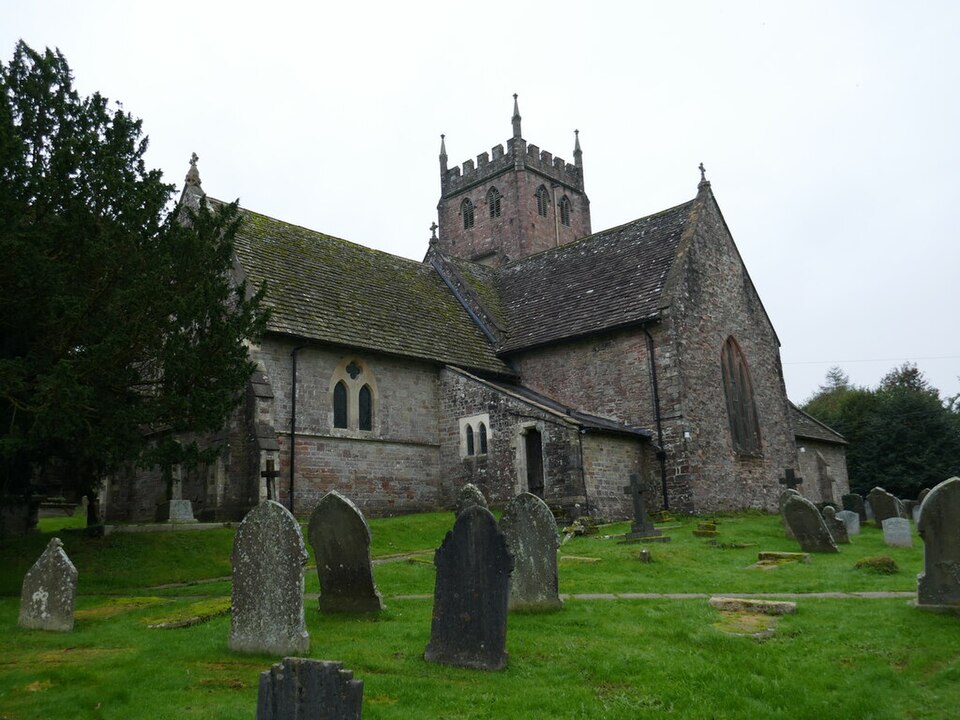
St Mary's, across the lane from the castle, under an honest Forest sky. The bread and cheese flies near here every Whit Sunday. Photo: Jonathan Thacker, CC BY-SA 2.0, via Geograph.
The stone that is missing here too
One more thread ties St Briavels to the rest of this season's walking. The parish had a great standing stone, the Long Stone, ten feet of it, in a field near Closeturf Farm. It was destroyed in 1875. The Bronze Age map of the Forest marks it as serenely as if it were still standing, and our Staunton article tells that story properly: the stones that survive are not the strongest, they are the luckiest. St Briavels drew the other card.
Down to the river
The village stands about two hundred metres above the Wye, and the classic walk falls off the ridge westwards through the woods to Bigsweir, where a single graceful iron span of 1827 carries the road over the river. Stand in the middle of Bigsweir Bridge and you are on the border: England behind you, Wales in front, and beneath you a river that is still tidal at this point, fifteen miles from the sea, keeping the sea's appointments this far inland.
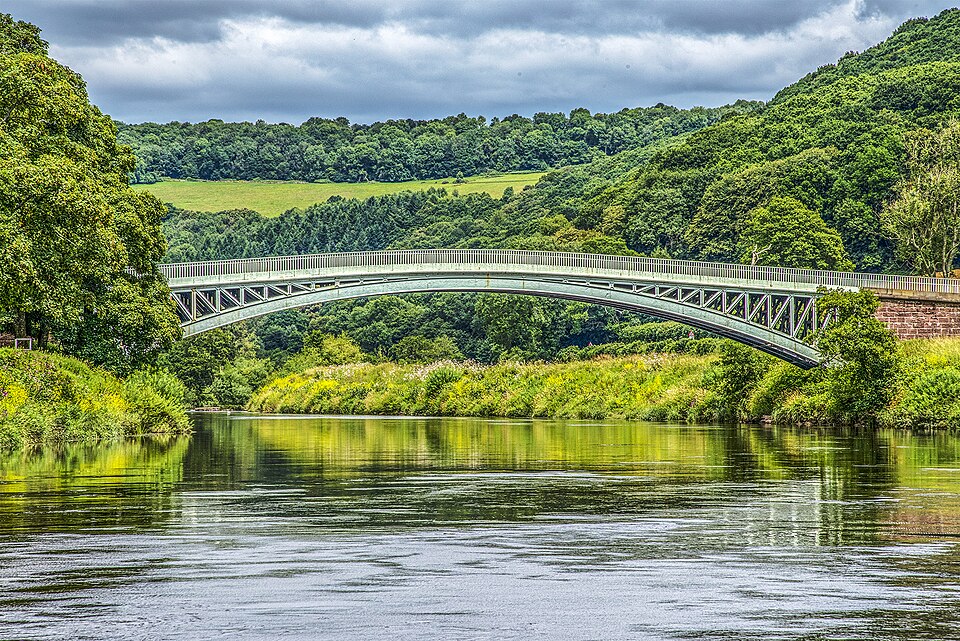
Bigsweir Bridge, one iron arch of 1827, with England and Wales holding an end each. Photo: David James, CC BY-SA 4.0, via Wikimedia Commons.
On the slope south of the bridge is the Hudnalls itself, the ancient wood all that bread and cheese has been protecting: a real working wood where real rights are still exercised, not a park. Walk its paths like a guest, because legally and morally that is what you are. And across the water sits Llandogo, named for St Oudoceus, whose stone by the Wye made a cameo in our Staunton article, in case you were somehow still under the impression that any of these valleys' stories stay in their own parish.
The walk back up is the price of the walk down. Pay it slowly.
If you go
St Briavels is ten minutes from Lydney and about fifteen from Chepstow or Monmouth, up steep lanes from the A466. The castle is a working YHA hostel inside an English Heritage monument: staying a night is the reliable way to see the inside, day access is limited and seasonal, so check before building an afternoon around the interior. The church, the green, the gatehouse from outside and the walks cost nothing and need no booking.
Two plain notes, and they are not jokes. The lanes are narrow and blind in places, so walk them with your ears on. And the descent to Bigsweir is a real two hundred metres down and the same back up: good shoes, water, and honesty with yourself about your knees.
If you want the bread and cheese, it is Whit Sunday, once a year, after the service. Catching a piece is supposed to be lucky. Eating it is reported to be optional.
If you are staying in the Wye Valley
You probably drove under this village without knowing it: the A466 runs along the river at its feet. Tintern and its abbey are fifteen minutes downstream and get the coaches. St Briavels is what the same valley looks like when the story went on being lived in instead of being ruined picturesquely: the castle got a use, the rights got kept, the cheese still flies. Do the abbey in the morning for the grandeur, then come up the hill for the continuity.
A note on this one
This is the third field note out of one museum visit, and the one the other two were pointing at. The Staunton article met the Hundred's lost Long Stone; the Soudley article met freemining in the museum's replica mine; St Briavels is where both threads live, and the research mostly consisted of following them home.
The fact that needed the most care is the biggest one: the freeminer qualification. It is quoted here from the Dean Forest (Mines) Act 1838 itself, which is readable in full on legislation.gov.uk, rather than from any retelling, because a right that is still exercised deserves its own words. The 2010 admission of women to the register is the Freeminers Association's and the record's. And the quarrel numbers, a thousand a day, come through English Heritage and the excavation literature, not folklore: the folklore here needed no help.
One number in this article is the parish's own and is flagged as such: the age of the churchyard yew. The parish has put it at some thirteen hundred years; the parish website was offline when this was checked, the Ancient Yew Group's database has no entry to settle it, and yew dating is contested at the best of times. The tree is unarguably ancient, the figure is reported speech, and the seed sheet has a note to go and measure the girth properly. Some fact-checking is best done with a tape measure and an afternoon.
other places nearby somebody has already marked in the app.
everything above is checked. if we could not find a source for something, it is not in here.
- English Heritage: the history of St Briavels Castle
- St Briavels Castle, Wikipedia: the hunting lodge, the quarrel works and the debtors' prison
- Victoria County History, St Briavels (British History Online): the parish, the Hundred and the Long Stone
- The Dean Forest (Mines) Act 1838, the freeminer qualification in its own words
- Royal Forest of Dean Freeminers Association
- Freeminer, Wikipedia: the Hundred, the Gaveller, and the first women on the register
- Calendar Customs: the St Briavels bread and cheese scramble
- Oxford Reference: bread and cheese throwing, first recorded 1779
- The Forest Review: bread, cheese and a sermon at St Briavels, the custom as it runs today
- Britain Express: St Mary's church, St Briavels, the font and the building's history
- Ernest Bryson, Wikipedia: the Liverpool composer who gave St Briavels its cathedral-pattern organ
- Visit Gloucestershire: discover St Briavels, the bells and the bread and cheese rhyme
whimsee is a little app for wandering. people leave small glimmers of wonder in places like this one, and other people go and find them. no feed, no algorithm, just a reason to go outside.
see how it works