Parkend: the iron village where everything gets a second life
A steam railway that was a coal tramroad, a goshawk viewpoint that was a colliery spoil heap, oaks where the nest boxes have been watched since 1948, and a four storey engine house that became a forestry school, a wartime billet and a house full of schoolchildren. A day in Parkend, in the middle of the Forest of Dean.

by sea, whimsee's creatorwhimsee field notes · Parkend · 10 August 2026
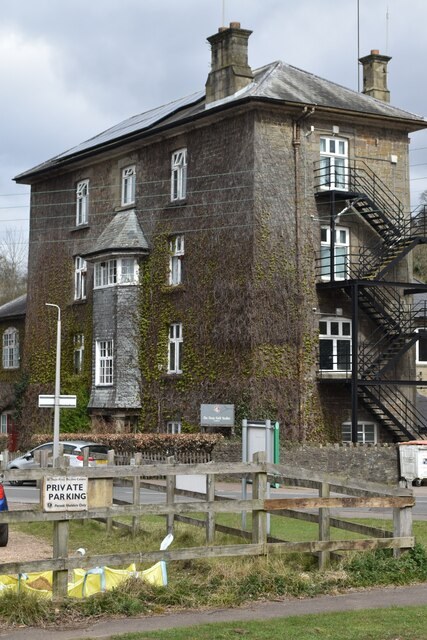
Most villages get to retire. They have their working years, and then the industry leaves and they settle into being pretty, and the past becomes a plaque. Parkend never managed it. Everything this village built for one purpose is now busy doing another: the coal railway carries holidaymakers, the colliery spoil heap carries birdwatchers, the ponds dug to drive a waterwheel carry ducks, and the building put up to blow air into blast furnaces is, at this moment, probably full of schoolchildren from Bristol learning to build a coracle.
The Forest of Dean is good at second lives. Parkend is where it shows its working.
Arrive by steam, if you can
Do the arrival properly. The Dean Forest Railway runs about four and a half miles up from Norchard, on the edge of Lydney, through the trees to Parkend, behind steam on most running days. In a long dry spell the volunteers swap steam for heritage diesel, because a spark from a chimney is not a thing to loose on a parched forest, and a railway run by people who love a forest takes that seriously.
The line is much older than its politeness. It began in 1810 as a horse-drawn tramroad, built to get coal and iron out of this valley down to the Severn. Parkend station opened to passengers in 1875, closed to them again in 1929, and kept working freight for decades more: the last goods train left on 26 March 1976. Volunteers reopened the station on 19 May 2006, and the level crossing gates beside the platform are reputedly the longest in Britain, built to close off a road's worth of industrial traffic at once. The freight this line was made for has gone. The trains, against all economic sense, have not; that is entirely the volunteers' doing.
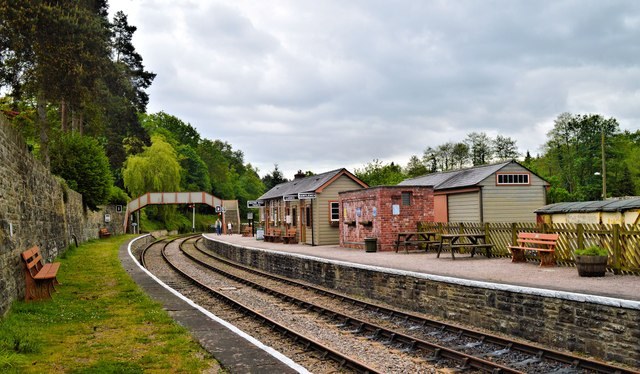
Parkend station, the top of the line. Coal went south through here for a century and a half; now the traffic is tea and day trippers. Photo: Philip Pankhurst, CC BY-SA 2.0, via Geograph.
The green over the din
Step out of the station and Parkend is a quiet place: a green, a scatter of stone cottages, a pub. Part of the Fountain Inn has stood since 1767, which makes it the oldest building in the village, and it has therefore seen everything that follows.
The name is honest. Parkend is the end of Whitemead Park, a royal enclosure first recorded in 1278, and for centuries that is all it was: the edge of somewhere else. Then iron happened to it, twice. King James I built a charcoal-fired furnace at "Parke End" in 1612; the King's Ironworks ran badly, in the way of most projects commissioned from a distance by somebody who will never visit, and closed in 1674. Coal is first recorded here in 1718. In 1799 a new ironworks went up and failed within a decade. And then, in 1824, a man named Moses Teague worked out how to make good iron from Forest coke, formed the Forest of Dean Iron Company, and lit Parkend properly.
For the next half century this green was one of the loudest places in Gloucestershire. An ironworks with, eventually, three blast furnaces. Coal pits around and beneath it. A stoneworks from 1850, a tinplate works from 1853, and a railway hauling all of it away. Then the trade turned, the works closed one by one, and by 1932 every major industry in Parkend had stopped. The forest closed over the lot within a generation, with the unhurried thoroughness of something that had been waiting.
The building that would not stop working
One building refused to go down with the rest.
The Forest of Dean Iron Company did nothing by halves. To blow air into its furnaces it built a waterwheel fifty one feet across and sixty tons in weight, reputedly the largest in Britain at the time, fed by a leat a mile and a half long from ponds dug at Cannop for that one job. When the wheel was not enough, steam engines came, in 1828 and 1849, and a great stone engine house to hold them: four storeys, walls battered like a fortress, built to shake all day and not mind.
The ironworks closed in 1877, when the iron trade went into recession and took the Forest's furnaces with it. Between 1890 and 1908 the demolition crews removed almost everything else. The engine house was spared, and its listing now calls it arguably the best preserved building of its kind in the United Kingdom, which is what happens when a building is too solid to be worth knocking down: it wins by outlasting the argument.
The second career started around 1908, when the Crown converted it into a school for training working foresters, the first of its kind in the country. A building that had spent fifty years blowing fires now taught people to grow trees. In the early 1970s it was bought by Avon County Council and became the Dean Field Studies Centre, and today it is the Deanfield Outdoor Centre, run by Bristol City Council, with a hundred beds and a steady traffic of city children out among the oaks. A building raised to consume a forest, spending its retirement introducing children to one.
A plain note rather than a joke: the engine house is a working residential centre for school groups, not a museum. It fronts the public road and is magnificent from the pavement, and the pavement is where the visit happens.
The war came through
During the Second World War the War Office commandeered the forestry school, and American soldiers were quartered in it: the record has the building serving the US Army as a base for its troops in the Forest, of which there were many, because a large quiet forest with its own railways is a useful thing to an army preparing an invasion.
Village memory keeps a more detailed version. In a local history group, this building is remembered as housing a Women's Land Army school, said to be the best in the country, running through the war, with the Ninth Air Force's service command keeping offices on one floor from 1943 to 1945. The Women's Timber Corps, the Land Army's forestry arm, really did run one of its four training camps for England and Wales in the Forest of Dean, and the corps' record names that camp "Lydney", which is Parkend's postal address, in the district whose one famous forestry school stood in this exact building. And the IX Air Force Service Command really did come to England in the autumn of 1943, though its own history puts its headquarters at Sunninghill in Berkshire, which suggests that what one floor of Parkend held was an outpost of that sprawling organisation rather than the thing itself.
The memory and the record are probably the same facts wearing different addresses, and the record is not automatically the better dressed of the two.
A church in two shapes at once
Walk east from the green and St Paul's appears: built in 1822 by the Reverend Henry Poole for a village that was about to boom, and built strangely, octagonal and cruciform at the same time, its arms thrown out from an eight-sided heart. Churches are usually one shape or the other. Poole's could not decide, chose both, and got away with it. It was raised for an iron village of furnace men and colliers; the industry it was built to serve has vanished around it, and the church stands in the quiet it was never designed for, looking rather pleased about it.
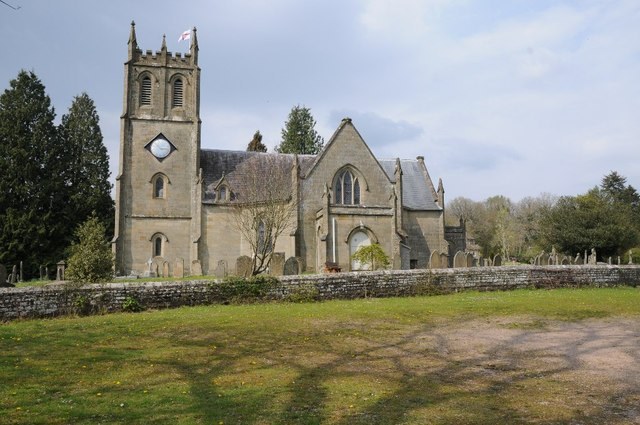
St Paul's from the green side. The octagon hides in the middle; the arms give it away. Photo: Philip Halling, CC BY-SA 2.0, via Geograph.
The park the village is named for
Whitemead itself is still there, at the southern edge of the village, on the far side of Cannop Brook. For six centuries it was what its name says, a park. From 1814 it held the office and residence of the deputy surveyor, the Crown's officer for the actual trees, and it stayed the working headquarters of the Forest's woods right through the Forestry Commission years, until the Civil Service Motoring Association bought it in 1970 and opened it as a caravan site the year after. Today it is Whitemead Forest Park: log cabins, glamping pods, over a hundred pitches for tents and caravans, and an indoor pool for the days the forest is being rained on. It is a private holiday park rather than a sight, so it is a place to stay, not a stop on the walk.
The Forest's ancient law, mind, was never at Whitemead. The verderers' Court of the Speech has sat since the 1670s at the Speech House in the middle of the Forest, and sits there still. That building earns its keep as a hotel now, and the courtroom doubles as the dining room, but the verderers still meet in it. The law at the Speech House, the work at Whitemead, and one of them never stopped.
The brook matters more than it looks. Parkend sits in a basin formed by Cannop Brook and its tributaries, and the brook is the water this whole story ran on: dammed upstream at Cannop to drive the great wheel, threading between Whitemead and the village, then carrying on south to Whitecroft, the next crossing downstream, where terraces went up before 1834 for the men of the Parkend pits. The ponds the damming left behind are today's Cannop Ponds, which have their own place in the Forest's summer field note.
The wood that was drafted
On the village's western edge begins RSPB Nagshead. More than half of it is oak from the early 1800s, and the oaks are Whitemead's doing: in 1814 Edward Machen, the young deputy surveyor charged with enclosing 11,000 acres of the Forest for naval timber after the 1808 Act, enclosed and replanted Nagshead, the main woodland of Parkend. The ships went iron, partly thanks to works like the one in the village below, and the oaks were left alone to grow into the tall broadleaf wood the reserve keeps now.
Then the war found a use even for the birds. In 1942, caterpillars of the oak leafroller moth were stripping leaves from timber the war effort needed, so nest boxes went up at Nagshead in the hope that pied flycatchers would breed in them and eat the caterpillars. The birds took the boxes. In 1948 the ornithologist Bruce Campbell began recording exactly what happened in them each spring, and the recording has never stopped: it is the UK's longest running bird breeding study, three quarters of a century of somebody writing down what the flycatchers did next.
Come in May or June and the descendants of those first recruits are everywhere: the male pied flycatcher is a small black and white bird with the quality of a woodcut come loose, flicking between oak trunks.
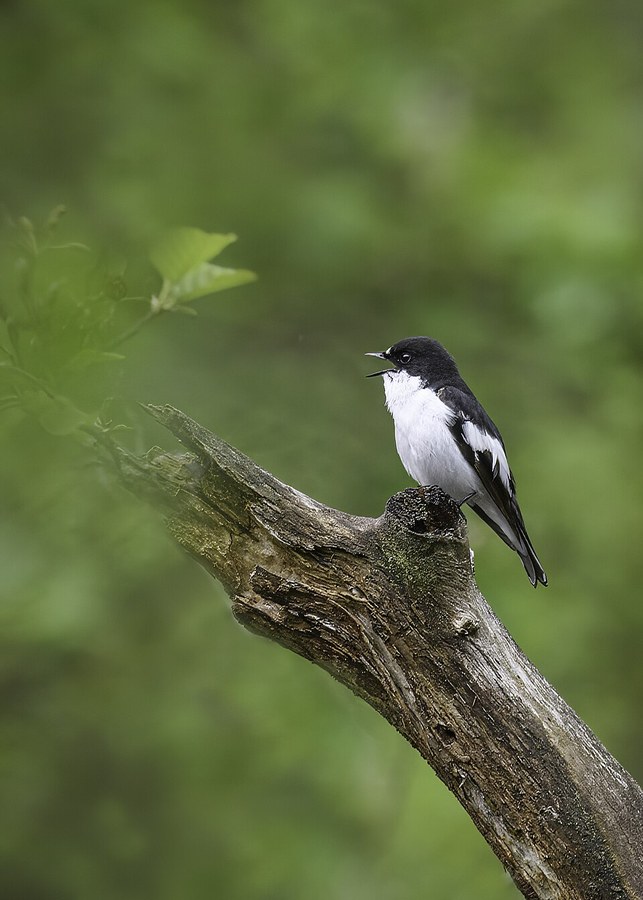
The bird the war recruited, in full song. Photo: caroline legg, CC BY 2.0, via Wikimedia Commons.
Spring brings redstarts and bluebells with them; summer is the season for all three British woodpeckers; winter strips the wood back to treecreepers and the occasional patrolling goshawk. Two waymarked trails loop through it, a mile and two and a quarter miles, steep and unsurfaced in places. Keep to them, especially in nesting season. The wood is mid-experiment.
The coal tip with the best seats in Britain
A mile and a half north east of the village, up the old railway routes and cycle tracks, stands a hill that is not a hill. New Fancy colliery dug coal from under this ground and piled its spoil into a great dark heap, and when the mine closed the Forest did what it does: trees, then a path, then a car park, then birdwatchers. The old lines ride well, too. Parkend has its own family-run cycle centre on Whitecroft Road, with everything from children's bikes to e-bikes and the family cycle trail on the doorstep, if wheels appeal more than boots.
Because the heap has become one of the prime sites in Britain for watching goshawks. The viewpoint on its summit looks out over an unbroken sweep of canopy, and in late winter and early spring, on clear still mornings, the big hawks rise out of it to display, climbing and plunging over the treetops while people who have driven a long way hold their breath at the fence. Goshawks were once persecuted out of Britain altogether. The comeback plays to a full fence of binoculars, from a stage made of mine waste.
At the bottom, Forestry England has laid a Geomap, a map you can walk across showing the forest's underlying geology with its mines and quarries marked, and beside it stands the Roll of Honour sculpture, installed in 2005, its three arms for the three things this forest was mined and quarried for: coal, iron and stone. The men who dug them are named there. Read the names, then climb their spoil for the view. It is a short steep pull, and the sunny slopes below the path are adder ground, which is one more reason the path is where you stay.
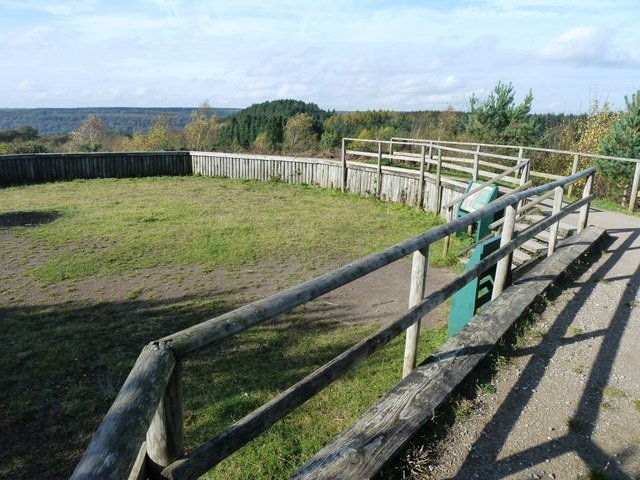
The summit of New Fancy. Everything in view to the horizon is what the goshawks display over in early spring. Photo: Clint Mann, CC BY-SA 2.0, via Geograph.
If you go
Parkend sits on the B4234 in the middle of the Forest, about ten minutes north of Lydney and fifteen from Coleford. The Dean Forest Railway runs from Norchard, which stays reachable from Lydney; it is a volunteer line, so check times and fares on its own site before building a day around it. Nagshead has a small free car park of about twenty spaces and a visitor centre open weekends and bank holidays from Easter to September; New Fancy has a free car park of its own. The village green, the engine house and the church are all within ten minutes of the station on foot. Dean Forest Cycles, the bike hire centre on Whitecroft Road, is open daily with a café attached, and if you want to wake up here, Whitemead Forest Park at the southern edge of the village takes everything from tents to lodges.
Some plain notes, and these are not jokes. The level crossing at the station is a working railway crossing on running days: cross where and when you are told to. The B4234 through the village carries real traffic, so walk it with your ears on. At Nagshead, stay on the trails, particularly from April to June when the wood is full of nests. At New Fancy, stay on the made path; adders bask on the open slopes, and they were here first. The Forest's wild boar wander through this area: give them room, more room if you have a dog, and all of it in spring when there are piglets. And the engine house is a children's residential centre, so it is admired from the public road, not the grounds.
Phone signal between the village and New Fancy is patchy. Sort your maps before you arrive.
If you are staying in the Wye Valley
You are twenty minutes away, and this is the other Forest. The Wye side does gorges and viewpoints and famous bends in the river; Parkend is the interior, the working middle where the coal and iron actually came from, now grown over and full of birds. Do Symonds Yat in the morning, then come inland, and you will have watched peregrines and goshawks in one day, from the two kinds of high ground this landscape owns: one carved by a river, one piled up by miners.
A note on this one
This article started in a conversation in a village history group, where the old field studies centre was remembered as part of Parkend Ironworks, a wartime Women's Land Army school said to be the best in the country, and the headquarters of the 9th Air Force Service Command from 1943 to 1945, with one floor for each story and a gentle argument in the replies about whether they could all be true at once. The best comment was two words long: "Engine house."
Chasing those memories through the record produced this page. The engine house, the ironworks, the forestry school, the War Office and the American soldiers all checked out. The Land Army school is remembered locally and fits the Timber Corps' own record of a Forest of Dean training camp it calls "Lydney", which is the postal address of this village; no source I could reach names the building itself, so that identification stays a likelihood rather than a fact. The IX Air Force Service Command's own history puts its headquarters near Ascot, so the Parkend floor was most plausibly an outpost, and the village remembered the organisation exactly even if the word headquarters grew in the telling. Village memory earned its keep here: it was more detailed than the record, and where they could be compared it was mostly right.
One date would not settle. The forestry school's opening at Parkend is given as 1908 by the county history, 1909 by a paper in the journal Forestry, and 1910 by the village's own accounts. This article says "around 1908" and leaves the three sources to argue among themselves, which, for a building on its fourth career across three centuries, feels close enough.
- What is the tall ivy-covered building in Parkend?
- It is the blowing engine house of Parkend Ironworks, built to hold the steam engines that blew air into the blast furnaces. The ironworks closed in 1877 and almost everything else was demolished by 1908, but the engine house survived to become the country's first training school for foresters, and its listing calls it arguably the best preserved building of its kind in the United Kingdom. Today it is the Deanfield Outdoor Centre, a residential centre run by Bristol City Council, so it is a working building rather than a museum: admire it from the road.
- Can you get to Parkend by steam train?
- Yes. The Dean Forest Railway runs about four and a half miles between Norchard, on the edge of Lydney, and Parkend, with steam on most running days. In long dry spells the railway swaps steam for heritage diesel, because a spark from an engine is not a thing to loose on a dry forest. Check times and fares on the railway's own site before you travel; it is a volunteer-run line, not a daily commuter service.
- When can you see pied flycatchers at RSPB Nagshead?
- May and June, when the birds are breeding in the reserve's nest boxes. Nagshead's boxes went up in 1942, and they have been monitored continuously since 1948, which makes it the UK's longest running bird breeding study. Spring also brings redstarts and bluebells; summer is good for all three British woodpeckers; winter brings goshawks and treecreepers.
- Where is the best place to watch goshawks in the Forest of Dean?
- New Fancy View, the old colliery spoil heap a mile and a half north east of Parkend. It has become one of the prime sites in Britain for watching goshawk display flights, with late winter and early spring the season: pick a clear, still morning, climb the short steep path to the summit, and watch the far canopy with patience and binoculars.
- What happened to Parkend Ironworks?
- It closed in 1877, when the iron trade fell into recession, and most of the works were demolished between 1890 and 1908. At its height it ran three blast furnaces, blown first by a waterwheel fifty one feet across, reputedly the largest in Britain at the time, and later by steam engines. The engine house that held those engines is the big ivy-covered building still standing in the middle of the village.
- Where can you stay in Parkend?
- Whitemead Forest Park, at the southern edge of the village across Cannop Brook, is a holiday park with log cabins, glamping pods and over a hundred pitches for tents, caravans and motorhomes, plus an indoor pool. The site is the actual Whitemead: the hunting enclosure recorded in 1278 that gave Parkend its name, and the office and residence of the deputy surveyor, the Crown's forest manager, from 1814 until the Civil Service Motoring Association bought it in 1970.
- Can you hire a bike in Parkend?
- Yes. Dean Forest Cycles on Whitecroft Road is a family-run bike shop, café, workshop and hire centre, open daily, with everything from children's bikes to e-bikes and mountain bikes for the graded trails. The family cycle trail around the old railway routes is on its doorstep, and New Fancy View is an easy ride from the village.
everything above is checked. if we could not find a source for something, it is not in here.
- Parkend Ironworks, Wikipedia: the furnaces, the great waterwheel, the closure and what survived
- Parkend, Wikipedia: the village, the railway, the church and the school
- Historic England: Dean Field Studies Centre (the former blowing engine house), list entry 1213931
- The Forester Training School, Parkend. Forestry, volume 28, 1955
- Victoria County History, Gloucestershire volume 5: Forest of Dean settlement, including Parkend
- Parkend village website: a history of Parkend
- The Women's Land Army site: the Timber Corps, and where its recruits trained
- IX Air Force Service Command: mission and lineage, including the move to Sunninghill in November 1943
- IX Air Force Service Command in the IWM's American Air Museum archive
- RSPB Nagshead: the reserve, the trails and the seasons
- Nagshead, Wikipedia: the 1942 nest boxes, Bruce Campbell and the longest running study
- Forestry England: New Fancy, the viewpoint, the Geomap and the miners' Roll of Honour
- BirdGuides: New Fancy View as a goshawk watchpoint
- Dean Forest Railway: the line, times and tickets
- Bristol City Council: the Deanfield Outdoor Centre at Parkend
- Whitemead Forest Park: the holiday park on the old Whitemead
- Warren James, Wikipedia: Edward Machen, the 1808 Act, and the 1814 replanting of Nagshead from Whitemead
- Dean Forest Cycles: the family-run hire centre on Whitecroft Road
- Speech House, Wikipedia: the 1682 lodge, the verderers' Court of the Speech, and the courtroom that became a dining room