The Kymin: the round house above Monmouth you can live in for a week
On a Friday evening above Monmouth, scouting somewhere to watch the eclipse, we met a couple staying in the Round House, the 1794 banqueting tower the National Trust lets you live in for a week. They invited us in for a look, and their route through Wales is worth borrowing.

by sea, whimsee's creatorwhimsee field notes · The Kymin · 9 August 2026
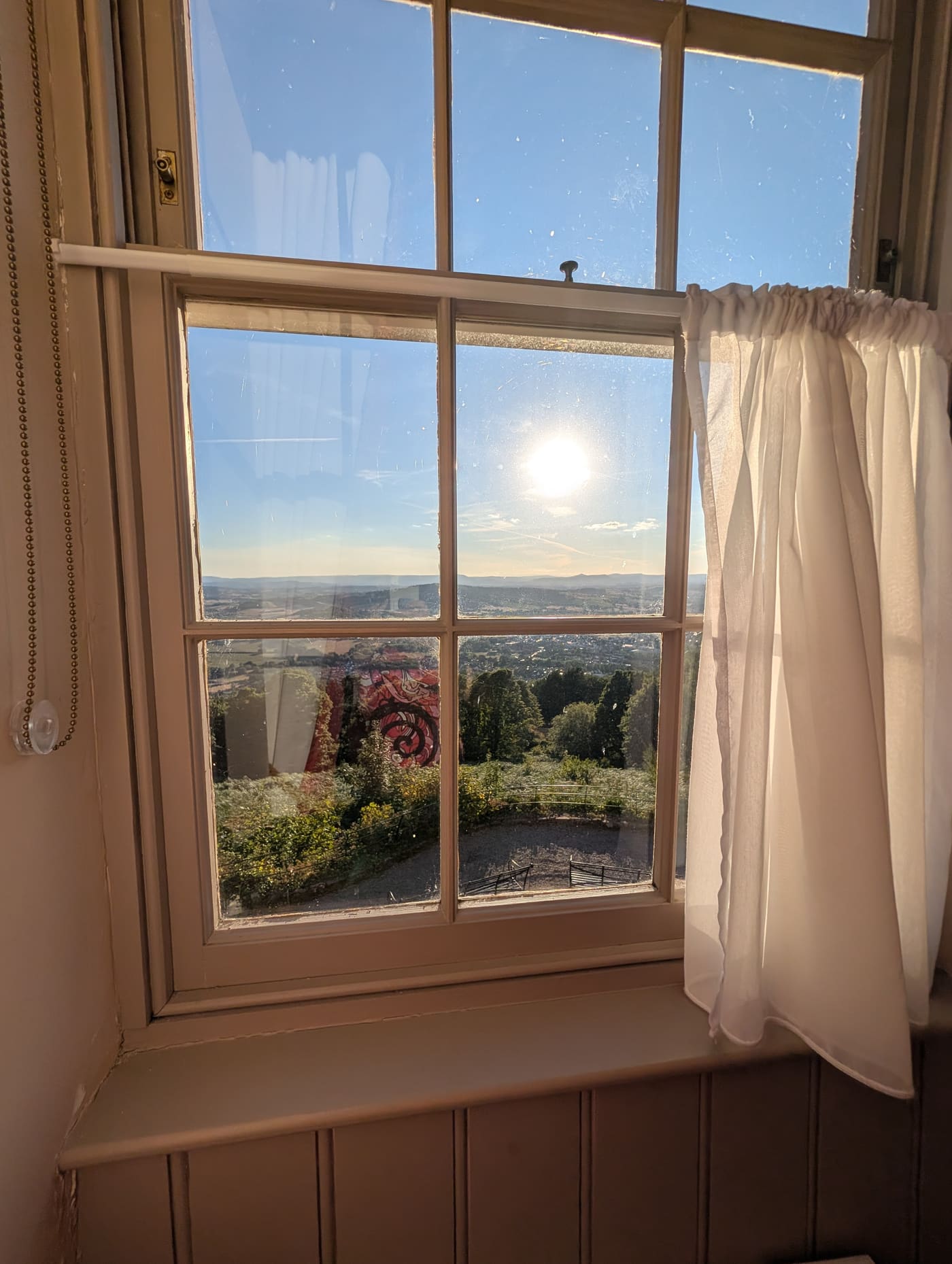
On Friday evening we walked up the Kymin, the hill that stands over Monmouth with a white tower on top of it. We were up there on eclipse business, scouting a place to watch Wednesday evening's partial eclipse, and the Kymin is a very good candidate: high, west facing, and generous with its horizon.
There was a couple sitting on the bench at the viewpoint. I said good evening, they said good evening back, and then one of them asked: are you local?
We were. They were not.
A tower built for dinner
The white tower on top of the Kymin is the Round House, and it was built between 1794 and 1796 by a circle of Monmouth gentlemen who called themselves the Kymin Club and met every Tuesday to dine together. They wanted somewhere to be sociable that had a view and a roof, in that order, so they raised a two storey banqueting tower by public subscription: kitchen downstairs, dining room upstairs, windows all the way round.
In 1800 the same picnic club built the Naval Temple a stone's throw away, honouring sixteen admirals and crowned with a figure of Britannia. Two years later Nelson himself came up the hill, with Emma and Sir William Hamilton, having travelled down the Wye by boat. He dined in the Round House and declared the temple the only monument of its kind erected to the Royal Navy in the kingdom. Charles Heath, Monmouth's tireless printer, claimed in 1807 that you could count ten counties from the summit on a clear day.
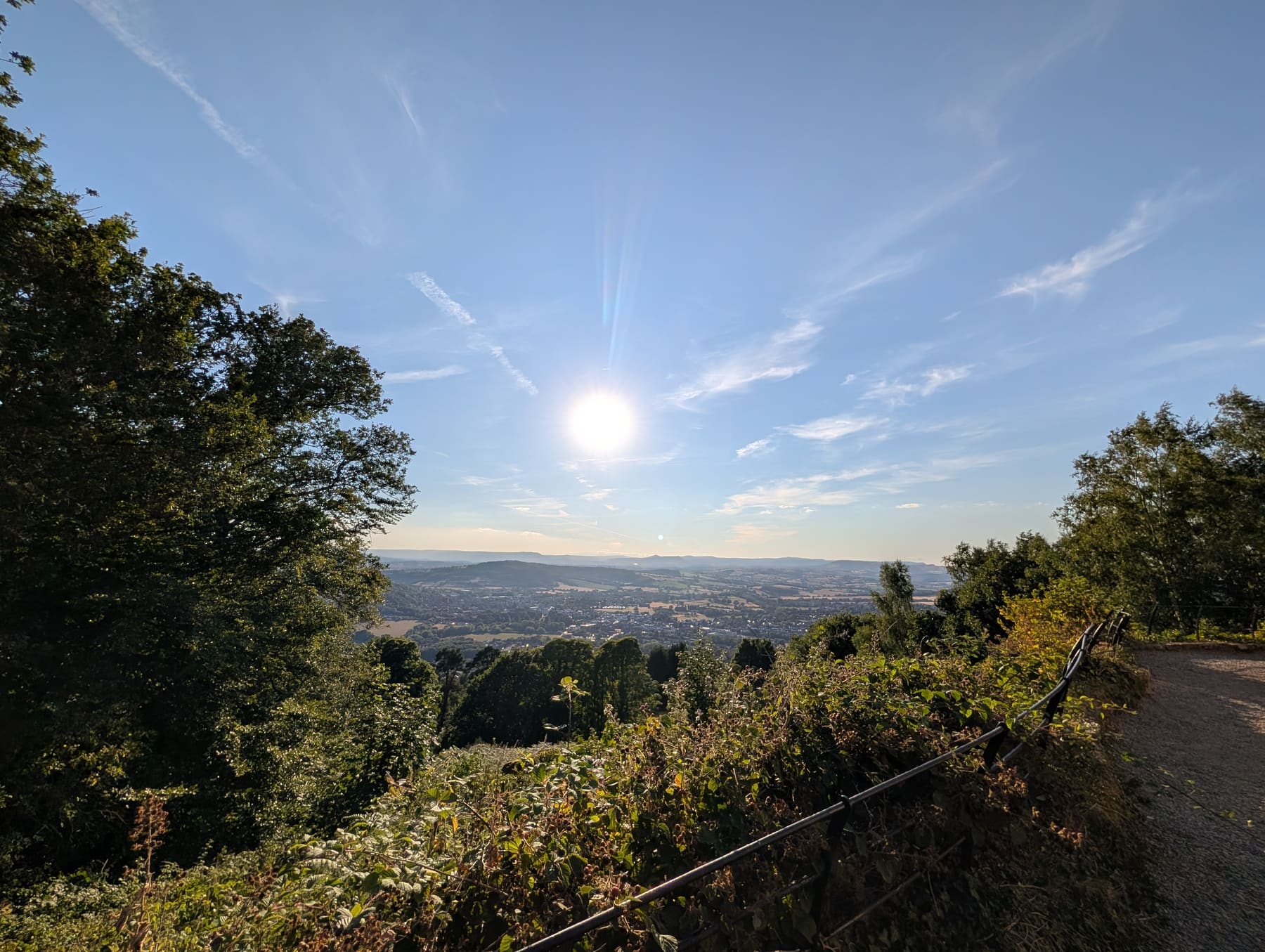
The evening in question. Monmouth below, half of Wales beyond.
The town gave the hill to the National Trust in 1902, and the parkland on top has belonged to everybody ever since.
You can live in it
The Round House is a holiday cottage, which surprises nearly everybody who finds out. The National Trust lets it, Thursday to Thursday, to two people at a time. The round living room is downstairs where the club's kitchen was, the bedroom and a roll top bath are up where the gentlemen dined, and every small window frames a different slice of the view the whole thing was built for.
There is no garden and no fence. The tower stands straight on the open parkland, so walkers and dog walkers and picnicking families drift past your windows all day. The upside is a steady supply of good evenings.
Base camp for a country
The couple on the bench, one recently retired from teaching, one who used to work in advertising, had booked the Round House for their summer holiday and were using it exactly the way the geography suggests. Monmouth sits where England leans into Wales, so from one round tower they were striking out in every direction: Bristol one day, then Pembrokeshire, then working their way up the whole Welsh coast to finish the holiday on Anglesey.
On Wednesday, while we are watching the eclipse from somewhere up here, they intend to be on the sand at Freshwater West in Pembrokeshire, watching it from Dobby's grave, the little memorial in the dunes where the Harry Potter films buried the best of their elves. It reads "Here lies Dobby, a Free Elf", and the National Trust, which cares for that beach too, asks visitors to take only photographs and leave no socks. An eclipse from a free elf's grave: some plans you simply cannot improve on.
I told them about whimsee, of course. I gave them one of our little wooden tokens, a papercut star burned into a square of birch, and told them how the app works: glimmers hidden in real places, warmer and colder, nothing to scroll. They turned the token over in the evening light and asked where they should try it first. They are going to see red kites on the way north, and somebody has already marked a spot for the kites in mid Wales, waiting for them.
Do you fancy a look inside?
We parted, the way you do, and my partner and I drifted over to read the information sign. And then a voice came across the grass: did we fancy coming in for a look?
We did the glance couples do, hers to mine, mine to hers, and went in.
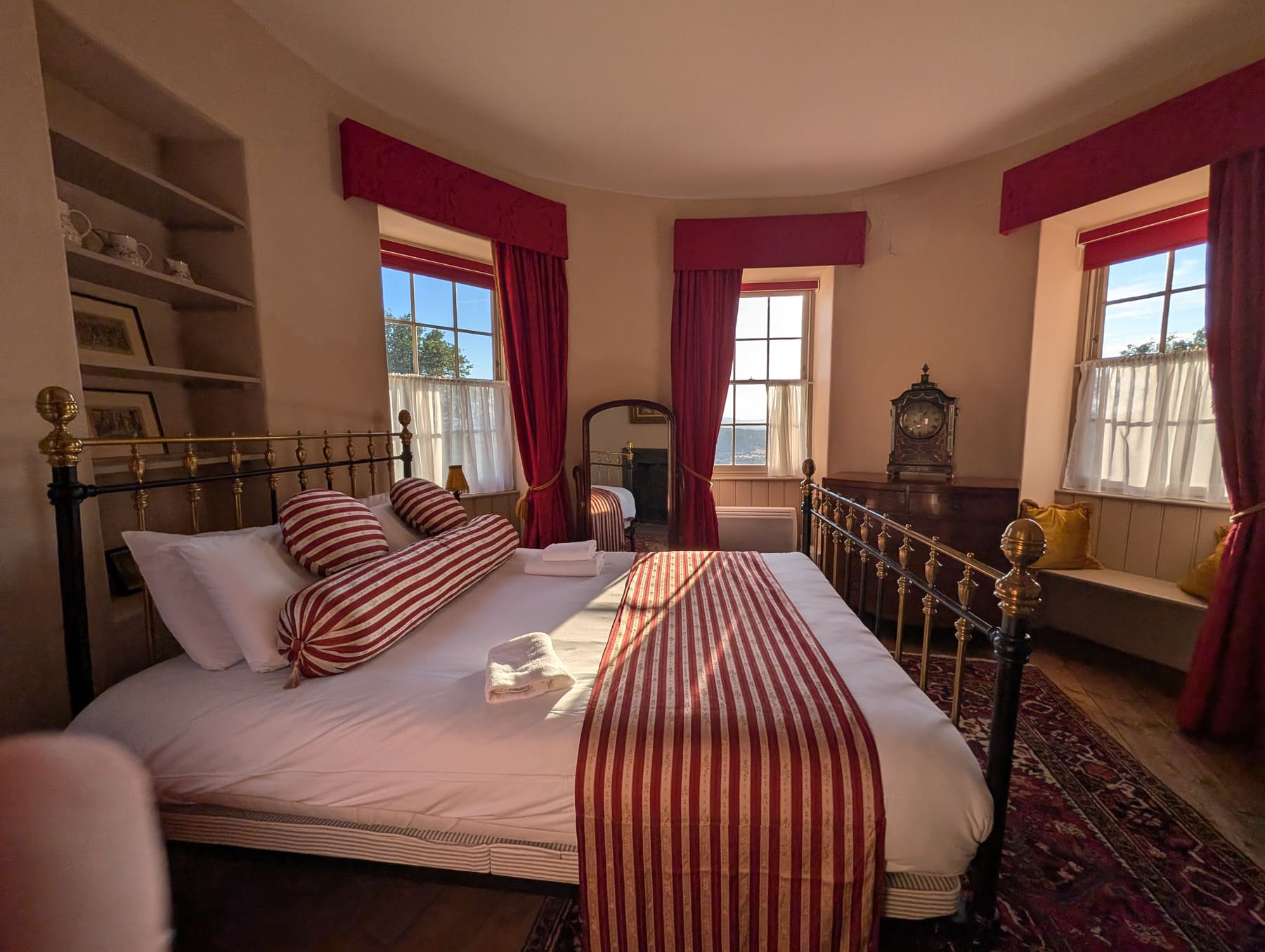
Upstairs in the Round House, where the Kymin Club dined. Every window has its own county.
It is tiny. It is also one of the best put together small spaces I have been inside: the bed, the shelves in the curve of the wall, the little clock, all exactly where they should be. They showed it off with the pride of people who briefly, properly, lived there.
If you are staying in the Forest of Dean
The Kymin is in Wales, but it stands on your side of the river: the Wye slips between the hill and Monmouth, and the border runs through the woods just east of the summit. Coleford is barely twenty minutes away by the A4136, and if you have walked the standing stones at Staunton you have already been on the neighbouring high ground; this is the next viewpoint along the ridge, the one with a tower on it.
If you go
The Kymin is a mile east of Monmouth, up a steep narrow lane, with a National Trust car park at the top; the Offa's Dyke Path crosses the summit, so you can also walk up from the town the honest way. The parkland and the outside of the Naval Temple and Round House are open to wander whenever the light is good, which up there is most of the time.
And if the tower's windows are lit while you are up there, remember somebody is on holiday inside. Say good evening if they are out on the grass. It went extremely well for us.
A note on this one
The couple are anonymous because they didn't know I would write about them. Everything historical, the club, the temple, the admirals, Nelson and his Hamiltons, Heath and his ten counties, is checked against the National Trust's own history and the sources below.
- Can you stay at the Kymin?
- Yes. The Round House, the 1794 banqueting tower on the summit, is a National Trust holiday cottage sleeping two, with the round living room downstairs and the bedroom and roll top bath upstairs. Stays run Thursday to Thursday, and the tower sits on open parkland, so walkers will pass your windows.
- What is the Naval Temple at the Kymin?
- A small monument built in 1800 by the same Monmouth picnic club that built the Round House, honouring sixteen Royal Navy admirals and topped by a figure of Britannia. When Nelson visited in 1802 he called it the only monument of its kind erected to the Royal Navy in the kingdom.
- Did Nelson really visit the Kymin?
- He did. Nelson came to Monmouth in August 1802 with Emma and Sir William Hamilton, travelling down the Wye, and went up the Kymin to see the Naval Temple and dine in the Round House.
- How high is the Kymin, and what can you see?
- The hill stands 256 metres, about 840 feet, above the Wye just east of Monmouth. Charles Heath's 1807 account claimed ten counties were visible from the top on a clear day, and whatever the modern count is, the Sugar Loaf and the mountains of Bannau Brycheiniog line up along the horizon.
everything above is checked. if we could not find a source for something, it is not in here.
- National Trust: the history of the Kymin, the picnic club, the Round House and the Naval Temple
- National Trust holidays: the Kymin Round House
- The Kymin (Wikipedia): the Kymin Club, Nelson's 1802 visit and Heath's ten counties
- BBC News: Dobby's grave at Freshwater West, and the ask to take only photographs