Piercefield: the cliff walk that invented the day out
Three hundred years ago a man stood on this cliff and decided the view was worth building for. What he made became the first tourist attraction in Britain, and most of it is still here, under the moss, waiting to be walked.

by sea, whimsee's creatorwhimsee field notes · Piercefield Walks · 29 July 2026
You go in at the top of Chepstow, past the last of the houses, and the town gives up almost immediately. Two minutes of walking and it has gone, in the way towns do when they meet a decent wood and decide not to argue.
The path climbs, gently, and it climbs in a way that should tell you something. Feet do not wear a path this considerate. Somebody laid this. Every bend in the next two miles was put there on purpose, nearly three hundred years ago, by a man with an idea that had not properly occurred to anybody before.
The man who invented the day out
Valentine Morris inherited Piercefield in 1743, looked at a wooded cliff above a river, and decided that the view was the thing worth building for.
This is such an obvious thought now that it is hard to see it was ever a new one. But landowners built for the house, and the grounds existed to flatter the house, and that was simply how it went. Morris turned the whole arrangement around and pointed it outwards. He cut paths along the cliff to reach particular prospects. He took out trees so the river would appear at the exact moment he wanted it to appear, which is to say he edited a valley. And at each place worth stopping he built something small, so you would know you had arrived somewhere rather than merely being somewhere. The Alcove. Lover's Leap. The Double View. The Giant's Cave.
He was composing a walk, and then inviting strangers to come and take it.
They came. By the second half of the century people were hiring boats at Ross and floating down the Wye for no reason except to look at things, which had never previously been considered a reason to leave the house. It was the first packaged tourist route in Britain, decades before anyone thought of doing it to the Lakes, and Piercefield was the bit everyone came for. Morris did not just build a path. He invented Going Somewhere To Look At It, an activity that now occupies most of the planet every August, and he did it with a strong opinion about trees.
The money that paid for all of it was sugar money, from his family's plantations in Antigua.
One visitor counted twenty six structures along here in 1760. Forty years later there were nine. Which means that as you walk, somewhere just off the path, under two hundred and sixty years of moss and leaf mould, there are seventeen small built things that nobody has stood inside since before your great great grandparents were born. The wood took them. The wood is not discussing it.
Spring, if you have timed it right
Between March and May this slope does something faintly ridiculous. It turns white, and it smells overpoweringly as though somebody two fields away is making a very large lunch.
Wild garlic, acres of it, with bluebells and wood anemones coming up through. Pick a single leaf as you pass and roll it between finger and thumb, and it will still be on your hands when you get back to the car, and possibly the following day.
Look up while you are at it. Some of the yews here are around seven hundred and fifty years old, which means they were already five hundred years into the job when Morris turned up with his ideas about where the paths should go. They are too wide to get your arms round. Try anyway. Nobody is watching, and a tree that has been standing on one spot since the 1200s has witnessed considerably sillier behaviour than yours.
Through the cliff
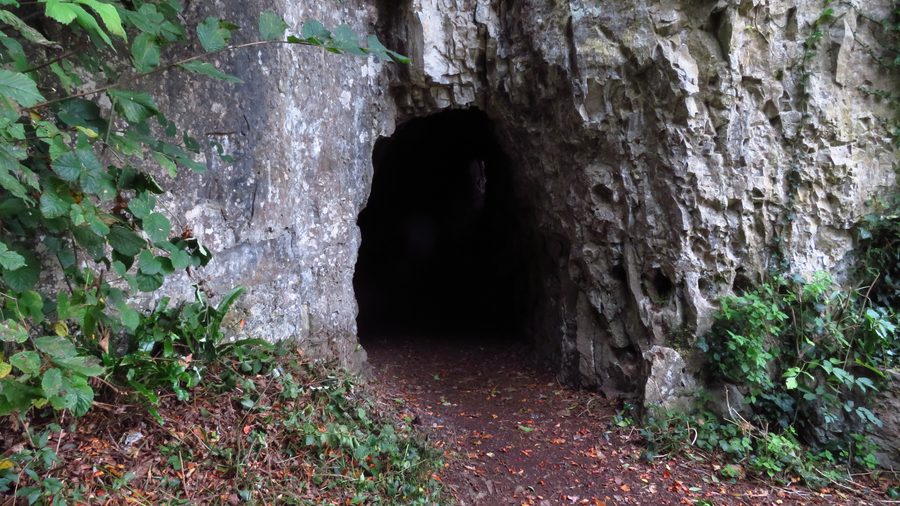
Then the path narrows, the rock leans in, and there is a hole in it.
The Giant's Cave is a tunnel cut clean through the cliff for no practical reason whatsoever, on the grounds that walking through solid rock feels tremendous. Morris understood something about people that a great many designers since have missed, which is that a view improves considerably if you have to go through the dark to get to it.
Over the entrance he installed a stone giant, holding a boulder above his head, frozen in the act of flinging it down on whoever came underneath. Frost got into him over the following century and he came apart, gradually, in the manner of most things that stand about outdoors looking menacing. So you have arrived too late to be frightened, which is a genuine shame. Go through anyway. It is short, and uneven, and darker than you have prepared for, and then the light on the far side does something with the river that no photograph has yet managed.
Morris's visitors were given stranger instructions than you will be. They were advised to bring gunpowder with them and hand it in to the gardener, so that a small cannon could be let off from the rock as they strolled past, for the echo. It is worth sitting with that for a moment: the correct etiquette for visiting a beauty spot in 1770 involved arriving with explosives and giving them to staff.
We are quieter about it now. But the tunnel still answers if you say something into it, and in two and a half centuries of people coming through here, almost nobody has managed not to try.
While you are standing in a hole somebody cut through this cliff, it is worth knowing about the one nobody cut.
The cave you will never see
Below this ground, running from the tidal riverbank away under Chepstow Racecourse, is Otter Hole: three and a third kilometres of passage, and the only major cave in Britain formed entirely within dolomite.
Deep inside it is a chamber called the Hall of the Thirty, filled with stalagmites in every colour from pure white through orange to absolute black. The black ones are black because of arsenic in the water that made them, which is the kind of detail that makes you glad geology is not usually in charge of interior decoration.
You cannot go and see it. Nor can almost anybody else. The way in is a gated door at the foot of a bluff by the river, access runs by permit through the Royal Forest of Dean Caving Club, and every trip goes with a warden. And then there is the tide, which is the real doorman, and which does not take bribes. A tidal sump floods the entrance passage twice a day and shuts the cave. So cavers either go in at low water and come out six hours later, or they go in knowing perfectly well that the sea is about to close behind them and they will not be coming out for somewhere between nine and fifteen hours.
A number of them choose the second one. That is how good it is down there.
The tide doing the shutting is the same one you can see from the cliff. The Wye at Chepstow rises and falls further than almost anywhere on earth, up to fourteen metres between low and high, which is why the river beneath you is either a river or an enormous quantity of mud, entirely depending on when you turned up.
The house in the trees
Carry on north and the wood opens on your left and there is a shell standing in it, roofless, and audibly full of jackdaws.
It is worth saying plainly what that shell used to be, because the word ruin makes it sound like it was always heading that way, and it was not. Piercefield House was designed in the style of Sir John Soane and it had an unpromising start: sold in 1793, unfinished and roofless, when the Monmouthshire Bank went down and took its owner with it. Colonel Mark Wood bought it the next year and finished it properly, with interiors by Joseph Bonomi that people travelled into Wales specifically to look at.
And then, for something in the region of a hundred and thirty years, it was not a ruin at all. It was a house. Somebody's actual home, with fires lit in it and children going up and down the stairs.
Nathaniel Wells
In 1802, eight years after it was finished, the entire estate was bought by a man called Nathaniel Wells, for ninety thousand pounds, in cash.
Wells was born on St Kitts in 1779. His father was a Welsh planter. His mother, Juggy, was an enslaved woman in his father's household. He was freed as a child, sent to school in England, and by the age of twenty three he owned one of the most admired estates in Britain, and the path you are standing on.
He kept going. Justice of the Peace in 1806. In 1818 the Prince Regent made him High Sheriff of Monmouthshire, the first Black man in Britain ever to hold the office, at a point in history when the country was still fifteen years away from abolishing slavery. In 1820 he was commissioned into the Chepstow troop of the Yeomanry Cavalry, only the second Black man commissioned into the British armed forces.
He also inherited his father's plantations in the Caribbean, and the people enslaved on them. Both of those things are in the record, and this valley is large enough to hold them.
But the part that matters while you are standing here looking at the shell is much simpler than any of it. He lived in this house for fifty years. He raised his family in it. He owned Piercefield longer than any other person ever has, before or since, and he liked the place enough to spend his own money on it and on the village up the road, where he turns up again shortly.
The house outlived him and went on being a home until 1925, when the Chepstow Racecourse Company bought it and took the interiors out. American troops stationed nearby spent part of the war shooting at what was left.
So: a house for roughly a hundred and thirty years, a ruin for a hundred. It has not yet been falling down for as long as it stood, and it is one of the most beautiful wrecks in Wales, and the jackdaws are extremely pleased with it.
Look at it from the path and leave it there. It is genuinely dangerous, and on private land, and it does not require you to be any nearer in order to be worth the look.
The village, which is not on this walk
The honest bit first, because the village is in the title of this article and you should know what you are being sold: you do not reach St Arvans by carrying on along the cliff. The racecourse lies between the two and the path has no interest in obliging you. The village is on the A466, two miles north of Chepstow, and the way to it is the road.
Go anyway. It is on the way to the Wyndcliff, so it costs you nothing but a turning, and when you get to the church, stop and look at the shape of the ground it is standing in.
The churchyard is round. Not vaguely round, not round-ish: deliberately, unarguably circular. That is the mark of somewhere extremely old, older than the building standing in it, older than the county, and almost certainly older than the road you drove in on. Somebody paced out a circle here around eleven hundred years ago and nobody since has been able to think of a good enough reason to rub it out.
Inside it stands a carved stone cross that has been upright for a thousand years, one of only three of its kind in the whole of Monmouthshire.
The village is named for St Arvan, a ninth century hermit who, tradition maintains, kept himself alive by fishing salmon out of the Wye from a coracle: a small round boat made of willow and a cow. He drowned when it went over, which, in fairness, is the principal risk of the design.
Eleven hundred years later, every single person who lives here says his name every time they say where they live. There are emperors who have done worse.
And the octagonal tower over your head, on the church: that was a gift, in 1820, from Nathaniel Wells.
What else is here
Hardly anybody mentions the wildlife, which is a pity, because it is the part that is still going on.
There are dormice asleep somewhere near you at this moment, curled up to roughly the dimensions of a conker, and you will almost certainly never see one. There is a beetle living in the old wood on this slope which has never been recorded anywhere else in Wales, and nobody can tell you which tree it is in, which is easily the best part. As far as this country is concerned it is the only one of its kind, and it has absolutely no idea.
Peregrines nest on these cliffs, and if a pigeon over the river suddenly panics for no reason you can see, you have just been given the reason.
You will walk past all of it without noticing. This is fine, and traditional. Morris's visitors walked past it too, being far too busy looking at the view he had arranged for them.
If you go
The walk runs north from the edge of Chepstow along the cliff to the Giant's Cave, and meets the Wye Valley Walk if you want to keep going. It is a little over a kilometre as the crow flies and a good deal more than that on your feet.
St Arvans is a separate trip and worth making it. Drive or walk up the A466 and the church is in the village, which also puts you most of the way to the Wyndcliff. Do not plan on strolling to it off the end of the cliff path.
Three plain notes, and these ones are not jokes. The cliff edges along here are real and some of them are unfenced, so keep to the path and keep hold of anyone small. The walks cross racecourse land and can close on race days. And the phone signal in the gorge ranges from poor to entirely theoretical, so download your map in the car rather than halfway along.
If you are staying in the Forest of Dean
The Forest is the far bank of this river rather than this one, but it is a fifteen minute drive and both sides belong to the same landscape: the Wye Valley National Landscape spans the water.
If you have ever stood at Wintour's Leap or the Devil's Pulpit and looked across the gorge at a wooded cliff wondering what was over there, this walk is the answer. It works in reverse too, and the view is better from this side, a fact this bank has been quietly enjoying for three hundred years.
There is a Forest connection underground as well. Otter Hole is managed by the Royal Forest of Dean Caving Club, and its dolomite is a close relation of the Forest's limestone, which is why this entire gorge is so full of holes.
A note on this one
Most of the history here is easy enough to find. The cave was not. The route through Otter Hole, and the fact that the Hall of the Thirty sits under the racecourse straight rather than under the walk, came out of a caving journal from 1979, in which one of the men who surveyed it wrote the passage up in bearings and distances.
Reading somebody describe crawling through a mud sump in 1979 in order to work out what is underneath a field in 2026 is a strange sort of pleasure, and it is why the sources at the foot of this page are worth your time every bit as much as the article is.
other places nearby somebody has already marked in the app.
everything above is checked. if we could not find a source for something, it is not in here.
- Wye Valley National Landscape: Picturesque Piercefield
- Piercefield House (Wikipedia)
- St Arvans Church: history
- St Arvans (Wikipedia)
- Nathaniel Wells (Wikipedia)
- RCAHMW: Piercefield House, a plantation owner, the son of an enslaved person, and a picturesque mansion
- Otter Hole (Wikipedia)
- Elliott, Westlake and Tringham, 'Otter Hole, near Chepstow, Wales', BCRA Transactions 6(4), 1979
- Gwent Wildlife Trust: Piercefield Woods nature reserve