The 365 Steps, and why nobody agrees how many there are
A Victorian staircase goes up the face of the Wyndcliff to the highest point on the Monmouthshire bank of the Wye. The name is a lie, the view is not, and a quarter of Britain's rarest bats live in the wood you climb through.

by sea, whimsee's creatorwhimsee field notes · Eagle's Nest · 29 July 2026
There is a car park off the A466 between Chepstow and Tintern which gives you no warning at all. You pull in, you get out, you look for the path, and there in the trees is the bottom of a staircase going more or less straight up.
It was built in 1828 by Osmond Wyatt, steward to the Duke of Beaufort, and everybody calls it the 365 Steps.
Start counting. You will not be the first
Almost everyone does. It is irresistible, and it is a trap, because nobody in two centuries has been able to agree on the number.
Count on the way up and you get one answer. Count on the way down and you get a different one. The modern reckoning is nearer three hundred than three hundred and sixty five, which means the name is accurate in roughly the same way that a village is "about a mile" away. People have been arguing about this at the top since before photography, and the arguing is now part of the walk, so pick a number, commit to it, and defend it.
The first stretch is genuinely pleasant. Mossy steps in dappled woodland, slightly uneven, the sort of thing that looks tremendous in a photograph. This continues for a while. It lulls you.
The bit where you regret it
Then it stops being pleasant and becomes a staircase up a cliff, and somewhere around the point you are sincerely hoping is halfway, you will have a short private conversation with yourself about the decisions that led here.
Keep going. That is the entirety of the advice this article has to offer. The regret ends quite suddenly, and within the hour you will be unable to remember the middle part at all, which is the brain doing you a favour.
While you are getting your breath back, consider what you are climbing through. This wood is doing two rather remarkable things at once and neither of them is advertised.
The first is bats. A quarter of every lesser horseshoe bat in Britain lives in this valley, the densest population anywhere in the country, and thirteen species of bat live in the Wye Valley in total. A lesser horseshoe weighs about the same as a 10p coin, which raises the question of how something that light manages to hold a firm opinion about anything, and yet a quarter of them have considered the whole of Britain and come down decisively in favour of this one valley. If you can contrive to be on these steps as the light goes, stop, and watch the air just above the path.
The second is a tree. There are whitebeams on this limestone that grow in the Wye Valley and almost nowhere else on the planet, holding on to bare rock at angles that look like a clerical error. You will walk straight past one. It will not mind. It has been getting along without being noticed for a very long time and has no ambitions in that direction.
The tea hut that isn't there
Near the top the path goes by a spot where, for years, there stood a small building called Moss Cottage, which sold refreshments to people who had just done what you have just done. It had a table in it made from timber out of Chepstow Castle. It fell apart and was pulled down in the 1950s.
Nothing marks the place. But it is a good thing to know as you pass, and if you ever come back up here carrying a flask, you briefly become the tea hut, and somebody would have been quietly pleased about that.
The top
And then the trees stop.
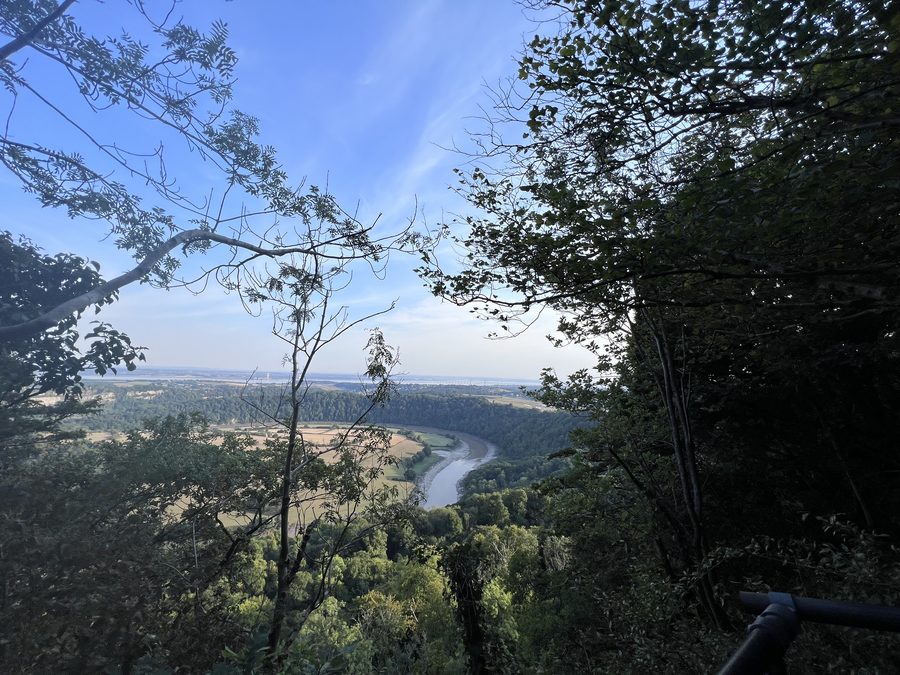
The Eagle's Nest is seven hundred and seventy one feet up, the highest point on the Monmouthshire bank of the Wye, and the river is a very long way underneath performing a hairpin turn. Beyond it the Severn estuary opens out flat and pale, and on a good day the two bridges sit in the distance looking less built than drawn.
People used to say you could count nine counties from up here on a clear day. Do not count them. Sit down for considerably longer than feels reasonable and look at it, which is the entire purpose of the staircase, and the reason a Victorian land agent went to the trouble of putting one up a cliff.
You will find Coleridge quoted at this viewpoint, on signs and in guidebooks: "the whole world seemed imaged in its vast circumference." It is a lovely line. It is also worth knowing that he wrote it in 1795 about a hill above his cottage at Clevedon, in Somerset, and there is no evidence he ever came within forty miles of this spot. People have been borrowing it for this view ever since, which is a compliment of a sort, and in fairness to them he was at least looking at the same water from further down the coast.
Come back in the fog
Nobody tells you this. The famous version of this view is the clear day, and the clear day is genuinely worth the climb.
But the other version, in which the entire gorge fills up with white fog and dripping trees and you can see about forty feet, is better. It is completely silent. It feels like standing at the edge of the map, in the part where the cartographer has given up and started drawing sea monsters. And you will have the whole thing to yourself, because nobody drives out to a viewpoint when there is nothing to view, which is their loss and entirely your gain.
Looking at the Forest of Dean
Almost everything visible from up here that is not water is the Forest of Dean. The wooded ground across the gorge, the cliffs at Wintour's Leap, the ridge running away north towards Symonds Yat: all of it the far bank, all of it England, and all of it about fifteen minutes away by road.
The Wye Valley National Landscape covers both sides of the river, so if you are staying in the Forest, this walk sits inside the same designated landscape you came for. It is also comfortably the best place to look at the Forest from, which is presumably why somebody went to the trouble of building a staircase up this side of the gorge and nobody has ever bothered building one up that side.
If you go
Two car parks serve it. Lower Wyndcliff, on the A466, puts you at the foot of the steps and gives you the full experience. Upper Wyndcliff, up a lane east of St Arvans, is much nearer the top and lets you miss out the staircase altogether, which is a perfectly respectable decision and also the civilised way of getting back down without your knees lodging a formal complaint.
The circular route takes around two hours. Straight up and back from the top car park is closer to one.
The steps are uneven in places and there is no shame whatsoever in using the handrail. Signal in the gorge is poor, so get your map downloaded at the car park rather than halfway up.
A note on this one
The Coleridge line very nearly went into this article unchecked. It is attached to this viewpoint all over the local writing, Wikipedia repeats it citing a tourism page, and it would have been extremely easy to print "a poet stood here and said this."
He did not. Tracking it back to a poem about a different hill took about ten minutes, which is roughly ten minutes more than it usually gets, and the true version turned out to be the better story anyway. That is nearly always how it goes, and it is why there is a list of sources at the bottom of this page.
everything above is checked. if we could not find a source for something, it is not in here.
- Wyndcliff (Wikipedia): the 365 Steps, Osmond Wyatt, the Eagle's Nest and Moss Cottage
- Wye Valley National Landscape: mammals, and the lesser horseshoe bat population
- Natural Resources Wales: Sorbus diversity in the Wye Valley Woodlands SAC
- Coleridge, 'Reflections on Having Left a Place of Retirement' (1795), the poem the quotation actually comes from