The concrete in the trees: Broadwell's American war
Walkers keep finding old foundations in the woods above Worcester Walk near Coleford, with fifty year old trees growing through them, and no map that says what they were. They are the remains of a wartime ammunition camp: British in 1940, American from 1943, part of one of the biggest US ammunition depots in England. The GIs, the segregated dance at Broadwell Community Hall, the Italian prisoners who built a monument to Marconi, and the archaeologists who finally put the huts back on the map.

by sea, whimsee's creatorwhimsee field notes · Worcester Walk · 17 August 2026
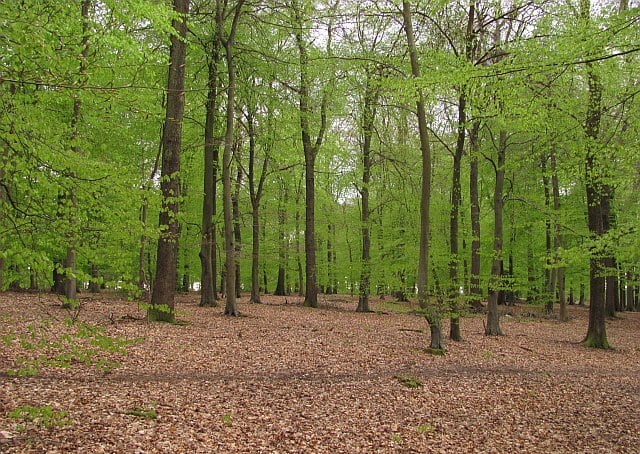
Walk into the woods above Worcester Walk, on the Broadwell edge of Coleford, and sooner or later your boot finds concrete. A rectangle of it, level and deliberate, with a birch growing up through the middle. Then another. Then a path that is too straight to be a forest path, going somewhere that no longer exists.
People keep asking what they were, and they are right to ask, because the maps are no help: nothing is marked there, and the trees growing through the slabs say whatever it was has been gone fifty years and more. The answer is that for a few years in the 1940s this quiet corner of the Forest was a military camp, and the Forest around it was one of the biggest ammunition stores in England. The concrete is what is left of the war in the Dean, and the story attached to it runs from Coleford to Normandy, by way of North Africa and Jim Crow.
An ammunition forest
It starts, as so much here does, with the trees. In 1940 Britain needed somewhere to put an enormous quantity of ammunition where one German bomb could not find all of it, and a forest is a roof that does not show up well from the air. The army came to the Dean, and engineers turned more than fourteen miles of woodland tracks into proper roads. Bombs, shells, mortars and grenades were stacked in the woods in their thousands of tons, sheltered and dispersed under the oaks.
The camp at Broadwell was planned in late 1940 to house the ordnance troops doing that work, a British unit with the unlovely name of No. 28 Ammunition Sub-Depot. The first men lived in tents; through 1941 and 1942 the tents became huts, Nissen huts of corrugated iron on concrete bases, and brick and concrete-framed buildings for the cookhouses and stores. The straight paths were laid then too. It was never a secret to the villages, whatever the maps said. You cannot hide nine hundred soldiers from the people whose pubs they drink in.
The Americans in the trees
In August 1942 the depot was handed to the US Army, and the scale changed. By 1943 the Forest of Dean sites were among the biggest American ammunition depots in England, with more than a thousand US soldiers living and working in the woods, around nine hundred of them at Broadwell. At the peak, roughly 160 railway wagons of ordnance a day were arriving at railheads at Parkend, Bilson Green, Cinderford and the Speech House, and the loads were driven out and stacked along the forest roads. Older Foresters remembered the verges of the Dean lined with shells the way they are lined with bracken now.
The villages remembered the men more than the ordnance. The GIs had sweets and chocolate in a country that had neither, and they gave them away; there were Christmas meals for local children in the middle of rationing, football against the Italians from the camp over the hill, and baseball, which the Forest watched with interest and declined to adopt.
Two sides of one wood
One part of this story has no warmth in it, and it should be told plainly.
The US Army that came to the Dean was racially segregated, and stayed so until 1948. Black and white American soldiers served in separate units, and at Broadwell they were housed apart: the memory still told in the villages is that white Americans lived on one side of the wood and Black Americans on the other. The same wood, the same war, a fence of rules down the middle of it.
The story the Forest kept is of a dance at Broadwell Community Hall, where white American soldiers on the door would not let Black American soldiers in. What the Foresters remembered afterwards was their own bafflement. These were men on the same side, wearing the same uniform, here to fight the same enemy, and the local people could not understand why they would fight among themselves. The Forest had its own long arguments, about fences of a different kind, but this one it looked at and did not recognise.
The prisoners and the magician of the ether
The war filled these woods from both directions, because a mile away at Wynols Hill stood Camp 61, a prisoner of war camp holding Italians captured mostly in the North African desert. There were 482 of them living in tents by July 1942, and 825 a year later, many working on local farms, in the sawmills and in the forest itself. It was, as these things go, a gentle captivity: the camp had a theatre group, an orchestra, education classes, and football against local sides. Some of the Worcester Walk huts took the overflow, and later in the war German prisoners passed through, waiting to go home.
In their spare time, out of whatever they could scrounge, the Italians built a monument. A tower with an internal ladder, concrete globes, doves, the shields of Italian cities, and an inscription in two languages: to Guglielmo Marconi, magician of the ether, the Italian prisoners of war, Christmas 1944. Marconi's radio work was turning fifty, and several hundred men a long way from home built a shrine to the technology that carried voices across distances like the one between Broadwell and Italy.
The monument stood at Wynols Hill for thirty years after the war. It was demolished in the 1970s for the housing estate that stands there now, even though the Italian consulate had offered money towards repairing it. Of everything this article had to check, that is the fact it most wanted to be wrong about.
D-Day, and the long emptying
The point of all of it arrived on 6 June 1944. The Dean's dumps were part of the supply chain behind the Normandy landings, and camps at Coleford, Cinderford, Lydbrook and English Bicknor emptied southwards as the American army left for the invasion, taking its ammunition with it. Up at Acorn Patch, off the road near the Speech House, the Forest held what was reputedly one of the biggest above-ground ordnance depots in the country, and among its stores was mustard gas, never used, sitting in an English wood in case the war became even worse than it was.
The clearing up took longer than the war. Acorn Patch was not declared fully safe until 1957, and the Broadwell camp lingered as buildings and then as rubble until it closed for good in 1958 and was demolished. The Forest grew back over the roads and the hut bases at its usual patient speed, which is how, within one lifetime, a camp of nine hundred men became a mystery that walkers ask about on local noticeboards.
What the diggers found
The camp got its map back in the end. As part of the Foresters' Forest heritage project, archaeologists from the Worcestershire Archive & Archaeology Service excavated the site with local volunteers, and what they recorded went far beyond what anyone expected: around thirty building structures, many never mapped in the camp's own lifetime. Nissen hut bases, concrete-framed buildings of pre-cast slabs, a toilet block that had been extended as the camp grew, the base of what may have been a watchtower, and here and there in the hut entrances, graffiti scratched into the concrete by the men who lived there. The whole site was recorded in 3D and entered into Gloucestershire's Historic Environment Record, which is the quiet, official way of saying: this is heritage now, it counts.
The loveliest finds are the smallest. A local family donated a handful of American uniform badges to the Dean Heritage Centre at Soudley: their mother had taken in the soldiers' laundry during the war, and the badges were what the GIs gave her. Somewhere between the thousand tons of ammunition and the fate of Europe, a woman in Broadwell washed shirts, and the thanks she got is in a museum case.
If you go
The woods hold the remains between Broadwell and Speech House Road, in the trees where Woodville Avenue meets Worcester Walk, and the forest here is open access: wander in and the concrete finds you within minutes. Go in winter or early spring if you want to read the site, before the bracken pulls the blanket back over it.
Three plain notes. Leave the remains exactly as they are: they are recorded heritage, and digging or metal detecting on Forestry England land is not permitted. This was an ammunition depot, so on the very small chance you see anything metal and military-looking in the ground, leave it alone and report it; the clearance was thorough, but thorough and perfect are different words. And the boar wander these woods like they wander everywhere in the Dean: give them room, more with a dog, most of all in spring with piglets.
Phone signal in the woods is poor. Sort your maps before you set off.
If you are staying in the Wye Valley
This pairs naturally with the Speech House, ten minutes along the same road: the courtroom that has argued about the Forest since Charles II in the morning, then the woods that hid an army in the afternoon. Or make it a war-and-remembrance day and go on to the Dean Heritage Centre to see the uniform badges themselves, small and bright in their case, the whole of this story folded into a museum drawer.
A note on this one
This article exists because of a question on a local noticeboard. Walkers in the Broadwell woods had found foundations with trees growing through them, looked at their maps, found nothing, and asked what the structures used to be. Within the hour the answers arrived, as they always do here: an army camp, the Americans, my uncle was one of the GIs, granny took in some of their washing. The Forest remembers. This is the long version of those answers, checked against what the archaeologists and archives could confirm.
Two things should be marked honestly. The memory that white and Black American soldiers lived on opposite sides of the wood is local telling, consistent with the documented segregation of the wartime US Army and with the Broadwell dance story, but this article could not find it in an official record, so it is reported here as what it is: what the villages remember. And the Marconi monument is genuinely gone; more than one telling has it still standing, and the photographs say otherwise. Its absence is part of the story now.
- What are the concrete foundations in the woods at Broadwell near Coleford?
- They are the remains of a Second World War military camp in the woodland where Woodville Avenue meets Worcester Walk. It was planned in late 1940 as a base for British ordnance troops handling ammunition stored through the Forest of Dean, built up with huts in 1941 and 1942, and occupied by American soldiers from 1943. Archaeologists excavating the site for the Foresters' Forest project uncovered around thirty building bases, many of which had never been mapped.
- Were American soldiers really based in the Forest of Dean in WW2?
- Yes, in numbers. The US Army took over the Forest's ammunition depot in August 1942, and by 1943 the Forest of Dean sites were among the biggest US ammunition depots in England, with more than a thousand American soldiers living and working here. Around nine hundred GIs were based at the Broadwell camp alone, and at the peak around 160 railway wagons of ordnance a day arrived at railheads at Parkend, Bilson Green, Cinderford and the Speech House.
- Why were there two separate camps for American soldiers?
- Because the US Army was racially segregated until 1948, and it brought that segregation with it. Black and white American soldiers served in separate units and were housed separately, and local memory holds that they lived on opposite sides of the wood at Broadwell. The story still told is of a dance at Broadwell Community Hall where white American soldiers on the door refused to let Black American soldiers in, to the bafflement of the Foresters, who could not understand why men on the same side would fight each other.
- What was Camp 61 at Wynols Hill?
- A prisoner of war camp at Wynols Hill in Broadwell, holding Italian prisoners captured mostly in North Africa. There were 482 living in tents by July 1942 and 825 by 1943, working on local farms, in the forest and in sawmills. The camp had a theatre group, an orchestra and football matches with local sides. German prisoners were held in the area later in the war, some at the Worcester Walk camp while awaiting repatriation. The camp itself was cleared after the war for housing.
- What was the Marconi monument at Broadwell?
- A monument the Italian prisoners of Camp 61 built in their spare time, finished at Christmas 1944 for the fiftieth anniversary of Marconi's first radio work, with a tower, concrete globes and doves, and an inscription in Italian and English to Guglielmo Marconi, magician of the ether. It stood at Wynols Hill for thirty years after the war and was demolished in the 1970s when the housing estate was built, despite the Italian consulate offering money towards its repair.
- Can I visit the WW2 camp remains at Broadwell?
- Yes. The woodland is open access forest on the edge of Broadwell, an easy walk in from Worcester Walk or the Speech House Road side, and the hut bases sit among the trees for anyone to find. Leave them exactly as they are: the remains are recorded in the county's Historic Environment Record, digging or metal detecting on Forestry England land is not permitted, and this was an ammunition depot, so anything metal in the ground should be left alone and reported, never picked up.
- Where did the finds from the Broadwell excavation go?
- To the Dean Heritage Centre at Soudley, the Forest's own museum. Among them are American uniform badges donated by a local family: their mother took in soldiers' laundry during the war, and the badges were what the GIs gave her.
everything above is checked. if we could not find a source for something, it is not in here.
- Worcestershire Archive & Archaeology Service: unearthing the WW2 camp remains at Broadwell
- Foresters' Forest: the Broadwell dig, No. 28 ASD, the nine hundred Americans and the thirty buildings
- The Forester: D-Day in the Forest, the 1942 American handover and the 160 wagons a day
- Sungreen local photo archive: the Marconi monument at Wynols Hill, built Christmas 1944, demolished in the 1970s
- Sungreen local photo archive: from El Alamein to Marconi, the story of Camp 61
- Heritage Open Days: the story of Camp 61 and the Marconi monument
- Wikimapia: the US Army ammunition depot at Acorn Patch, and the clearance that took until 1957
- NPR: the segregated US Army in wartime Britain