The wise woman of Cinderford: Ellen Hayward and the Forest's last witch trial
In a Cinderford churchyard stands a gravestone erected by friends for Ellen Hayward, the Forest of Dean's last person charged with witchcraft. She was no witch: she was a cunning woman, a herbalist who treated rich and poor, got asked about in Parliament after a strange outbreak of fear under May Hill, and was laughed out of Littledean court in 1906. People still leave coins on her grave.

by sea, whimsee's creatorwhimsee field notes · St John the Evangelist churchyard · 23 August 2026
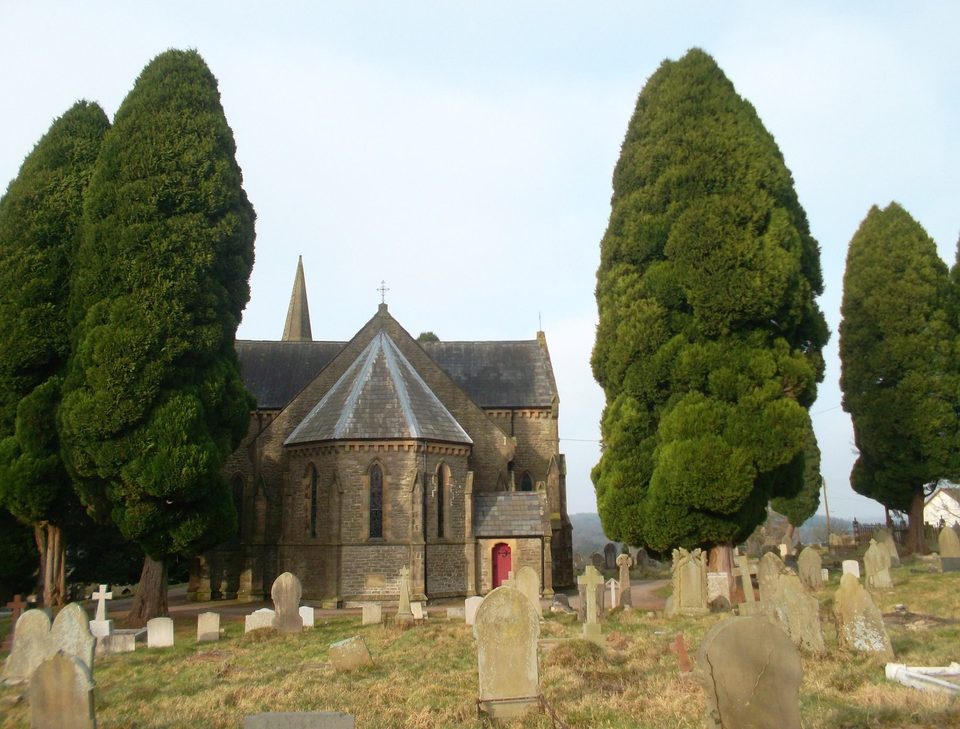
Plenty of graves in England get pointed at as a witch's grave. Most of the stories fall over the moment you tug them. This one stands up, though the woman under the stone would have had firm words about the label.
In the churchyard of St John the Evangelist at Cinderford, among the old headstones and the dark cypress trees, is a gravestone that reads, where the weather has left it legible: erected by her friends, in loving memory, Ellen Hayward, who died September 24th 1912, aged 74 years. Under that, a line of scripture: the path of the just is as the shining light. And people keep leaving coins on it.
Ellen Hayward was the last person charged with witchcraft in Gloucestershire. She was also, by every account her neighbours left behind, nothing of the kind. She was a cunning woman: a herbalist, a healer of people and animals, a listener, a fixture of Cinderford for decades. The distance between what she was and what she was accused of being is the whole story, and it is worth walking slowly.
The herbalist of Pembroke Street
Ellen was born at Arlingham in the late 1830s, on the east bank of the Severn, in the last big loop the river makes before it becomes estuary. Her early life was hard in the ways that rarely make it into legend: children born outside marriage in a century that punished that, a crossing of the Severn to Newnham in 1878 with her family and very little else, and a spell in the workhouse before she got her feet under her in Cinderford.
What she built after that is the remarkable part. From a small terraced house in Pembroke Street, with herbs gathered from the Forest hanging from the ceilings and, the stories insist, chickens wandering through the house, she became the person a whole district went to when something was wrong. People called her Wise Ellen, or Old Ellen. She treated the ailments of rich and poor alike, and livestock too: farmers came over from Herefordshire with sick animals. She reportedly charged no set fees, taking instead whatever people offered, which in the Forest in those years might be food or labour as easily as coin. The official records, being official, are drier about it: the census at the turn of the century has her down as a dressmaker.
A cunning woman, to be clear about the trade, was not a witch, and the distinction mattered enormously to the people who held it. Cunning folk were the useful ones: they cured, found lost property, lifted the frights and worries off people, and stood between their neighbours and the darker things those neighbours believed in. Every district had someone. The Forest of Dean, isolated, close, and stubborn about its old ways, kept its cunning folk later than most of England, and it kept Ellen busiest of all.
One of the trade's best tricks needed no magic whatsoever. If something was stolen, the victim made it loudly known that a cunning person had been engaged on the case, and rather often the stolen goods quietly came home. Fear of magic did the work, and nobody had to prove a thing. It is an elegant mechanism, right up until the fear stops being useful and starts being a fire. Which brings us to May Hill.
The trouble under May Hill
May Hill is the Forest's north eastern landmark, the rounded hill with the clump of pines on top, planted for Queen Victoria's jubilee, that you can see from half the county. In 1905 a family named Markey lived under it, and some money went missing from their house. Retellings put it at fifty pounds, a serious sum. Mr Markey went to consult a wise woman about it, which in this part of the world at that date meant Ellen.
What happened next had nothing to do with anything Ellen did, and everything to do with what the family believed. Within weeks the household had come apart in the most complete and terrible way. Three members of the family lost their reason and were taken to the asylum. Mrs Markey vanished and was found to have hidden herself in a wood for the better part of four days, and came back carrying a hazel stick for protection against witches. One of the family, the newspapers reported, drove a stick into his own eye. Neighbours began cutting hazel sticks of their own. The story ran through the local papers and then the national ones, gathering dread as it went.
It went all the way to Westminster. On 31 May 1905 an MP stood up in the House of Commons and asked the Home Secretary whether his attention had been called to the practice of witchcraft at May Hill and other parts of Gloucestershire, and to the ruin of the Markey family. The Home Secretary, Aretas Akers-Douglas, replied with the facts as the police had them, that the family had consulted a supposed witch about money they believed stolen, and added that if the evidence allowed, proceedings would be taken by the local police against the woman who was consulted.
Sit with that sentence for a moment. In the twentieth century, in Hansard, a British Home Secretary is discussing the prosecution of a Forest of Dean herbalist over an outbreak of what we would now plainly call collective hysteria. Nobody in the exchange suggests the woman consulted had done anything at all. The mere consulting was the scandal.
The man with the sick pig
The proceedings, when they finally came in May 1906, arrived from a different direction, and a stranger one.
A local farmer, James Davies, had trouble with his animals: his cows' yields, and a pig that sickened, recovered, and sickened again. He became convinced he had been cursed, and the name he put to the curse was a neighbour the accounts call Mother Amos. He went to Ellen for help, more than once, sending letters with money enclosed, begging.
Ellen's response, by the accounts that survive, is the best character evidence she could have left us. She gave him practical advice about the animals. She told him he was unwell himself and needed rest, which reads a century later as a rather acute diagnosis. What she absolutely would not do was the thing he actually wanted: when Davies offered her half a crown to curse the Amos family in return, she refused outright. A witch war was on offer, and the supposed witch declined the commission.
It did him no good, because his fear had stopped listening. Davies had also been talking to the local constabulary, and somewhere in the tangle of his terror and their duty, the file landed on Ellen. The woman who had refused to curse anybody was summoned before the Littledean magistrates, charged, in the wonderful strangled language of the charge sheet, with unlawfully using certain craft or means or device, to wit, by pretended witchcraft, to deceive and impose on one of His Majesty's subjects, to wit one James Davies.
Note the word pretended. Even the law, by 1906, did not believe in witchcraft. What it could still prosecute was the pretence of it, under statute language built for rounding up fortune tellers. She faced a magistrates' bench because a frightened man believed in magic and the law did not, which put the entire weight of the case on the one person in the story who had kept her head.
Laughed out of Littledean
The trial was brief, and it is the Forest's redemption in this story.
Ellen conducted her own defence. Witnesses described a small, slim, elderly woman in a long black coat and a black brimmed hat. Asked, in effect, whether she was a witch, she gave the answer she had given all her life: she was a herbalist by profession, and had nothing to do with witchcraft. She could not put a spell on anyone, she said, and had given Davies nothing more supernatural than a cup of tea. Davies, put to the test of explaining his own accusation, could not give a coherent account of it.
And then there were the letters. Some thirty letters arrived in support of her, from the people of Cinderford and around: testimonials to years of help, of cures, of kindness, of debts the neighbourhood knew it owed her. Read against the panic of the May Hill year, they are the other Forest speaking, the one that had been quietly bringing its sick children and its lame horses to Pembroke Street for decades and saw no reason to stop.
The magistrates threw the case out. Contemporary accounts say it was laughed out of court, which is the right ending but should not obscure the wrong middle: an elderly woman stood alone in a courtroom answering for other people's nightmares, and won because she was calm, sensible, and visibly loved. Gloucestershire never charged anyone with witchcraft again.
Erected by her friends
Ellen died at home in Pembroke Street in September 1912, aged 74, and was buried at St John the Evangelist. Some years later the community did the thing that turns a burial into a monument: her friends paid for a proper carved headstone, and put their reason in its first line. Erected by her friends. Not by her family, though family is there too, and not by subscription of the curious. By her friends.
The stone carries one more line, easy to miss under the lichen, that opens a quieter grief: also of Florence, her daughter, aged 8 years. Florence had died a quarter of a century before her mother. Whatever else Ellen carried up and down the Forest's hills with her baskets of herbs, she carried that.
And there is one more resident of the churchyard worth knowing about. The story goes that buried close by, facing her, is the police sergeant who worked the case against her. Cinderford is a small place, and its ground is honest: it keeps everybody, accuser and accused, a few yards apart, at peace, indefinitely.
The coins on the grave are a newer chapter. Visitors leave them on the plinth and the headstone, small silver mostly, the way people have made offerings at wells and tombs in this country since before anyone wrote things down. Perhaps it is for luck, perhaps a fee for a consultation a century too late. She took what people could afford. It seems she still does.
If you go
St John the Evangelist stands on the southern, Ruspidge side of Cinderford, a Victorian church of 1844 built for the iron and coal town growing up around it. The churchyard is open, and finding Ellen's stone among the cypresses is a proper small quest, which feels right: she should take a little finding.
Two plain notes. It is a working churchyard, with recent graves as well as old ones, so wander it the way you would want your own people's ground wandered: quietly, on the paths where there are paths, and with dogs on leads. And if you leave a coin, leave a coin, not a scratch or a rubbing; the stone is over a century old and the lichen is part of the memory now.
May Hill, where the fear began, is a half hour away on the Forest's north eastern shoulder and belongs to the National Trust. The walk to its jubilee pines is one of the great short climbs in the county, with the Severn looping below and, on a clear day, most of the story's geography in a single view: Arlingham in the river's bend where Ellen was born, the Forest's dark ridge where she worked, and the fields under the hill where one missing purse briefly drove a corner of England out of its mind.
A note on this one
This article began, as the best ones do, sideways: with a photograph of the gravestone shared in a local history group, and the sender's note asking, in effect, is there a story here. There is, and checking it turned up the usual crop of contradictions worth being honest about.
The legal detail is genuinely tangled. Retellings variously say Ellen was tried under the Witchcraft Act or under the Vagrancy Act, and one widely copied version cites a Witchcraft Act of 1753, which does not exist; the witchcraft statute of that century was 1735. The charge sheet's own words, craft or means or device to deceive and impose, are the Vagrancy Act's formula, with pretended witchcraft slotted in, and that act is the one the authorities of the period generally reached for against cunning folk. So this article says what the documents say and lets the label go. Whichever act it was, she is still the last person in Gloucestershire charged over witchcraft, and the case still got laughed out of Littledean.
Her death date is stubbornly doubled: the gravestone says September 24th, one records based account says the 28th. A stone carved years after the funeral and a register copied by hand are both capable of being wrong, and this article follows the stone, which her friends stood next to. Her birth year floats between 1838 and 1839 in the same way.
And the Hansard exchange, which sounds too neat to be true, is the easiest thing in the whole story to verify: Witchcraft in Gloucestershire, House of Commons, 31 May 1905, question by Mr MacVeagh, answered by the Home Secretary. It is in the official record, one click away in the sources below, a little astonishing every time.
- Where is the witch's grave in the Forest of Dean?
- In the churchyard of St John the Evangelist at Cinderford, on the Ruspidge side of the town. It is the grave of Ellen Hayward, a Cinderford herbalist and cunning woman who died in 1912. Her gravestone was paid for by her friends, and visitors still leave coins on it.
- Was Ellen Hayward really a witch?
- No, and she said so herself, in court. She was a cunning woman: a herbalist and healer who treated people and livestock across the Forest of Dean and took whatever payment folk could offer. Witch was other people's word for her, usually frightened people. Hers was herbalist.
- When was the last witchcraft trial in Gloucestershire?
- In May 1906, when Ellen Hayward of Cinderford was summoned before the magistrates at Littledean, charged with using pretended witchcraft to deceive and impose upon a local man. She conducted her own defence, some thirty letters of support arrived from the community, and the case was dismissed.
- Why do people leave coins on Ellen Hayward's grave?
- Leaving coins on a grave is an old custom of offering and respect, and at Ellen's grave it has quietly revived. Perhaps people hope a little of her luck or her skill rubs off. She took whatever her visitors could afford in life, so there is something fitting about it.
everything above is checked. if we could not find a source for something, it is not in here.
- Hansard, 31 May 1905: Witchcraft in Gloucestershire, the Commons question about May Hill and the Markey family
- Cheryl Burman: Tried for witchcraft in 1906, the charge sheet and the thirty letters
- Cheryl Burman: Wise men and women, the cunning trade Ellen worked in
- Haunted History Chronicles: In the Shadow of the Forest, Ellen Hayward's witch trial
- Forest of Dean Family History Trust forum: Ellen Hayward, herbalist, the records of her life and death
- Visit Dean Wye: myths and legends of the Forest of Dean
- Vagrancy Act 1824, section 4: the subtle craft, means, or device the charge sheet leaned on
- Historic England: Church of St John the Evangelist, Cinderford, the listing
- National Trust: May Hill, the hill where the fear broke out